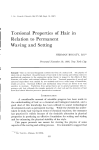
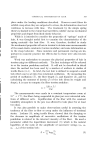
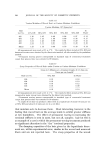
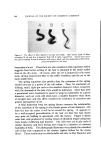
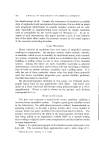
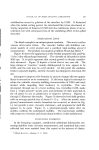
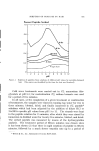
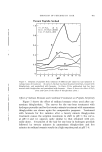
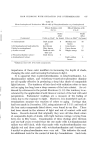
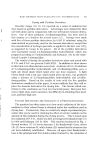
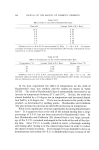
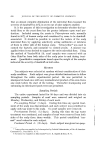
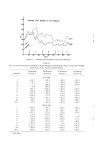
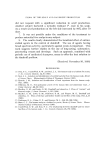
576 JOURNAL OF THE SOCIETY OF COSMETIC CHEMISTS Figure i. Photograph showing detail of hair tresses in the front hair line in a spiral coil arrangement immediately following permanent waving women's hair frequently assumes a helical coil configuration in the course of its being permanent waved, set, and combed into style. It will be further implied that hair assemblies in helical form can be treated qualitatively in terms of a classical physical model and that predictions of behavior based on this model fit moderately well with the observed behavior. Finally, since consideration of fibers in helical form involve physical properties in torsion, some measurements of the torsional stiffness and creep of single fibers are reported under various test condi- tions. OBSERVATIONS OF HAIR ON THE HEAD Let us first examine the process of wrapping hair on a rod for a permanent-waving treatment. The hair is arrayed with the fibers parallel in the form of a little tress. When it is wound in a cylindrical form around a waving rod bending forces are applied. When the rod is removed at the conclusion of the waving process the tip end of the hair hangs free and the hair tress is converted thereby into a helical coil. This results in the development of shear or torsional forces in the indi- vidual fibers. The coil arrangement can very easily be seen by looking at the heads of women just at the completion of the waving procedure. Figure 1 is a photograph of the typical arrangement of women's hair just after removal of the rods in a permanent-waving process. The helical coils and spiral arrangement of the groups of fibers are very evident. Spiral coils like these in permanent waved hair are also seen in naturally curly and wavy hair. Coils of varying degrees of regu-

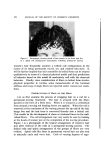
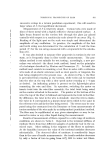
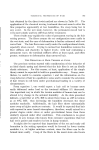
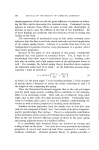
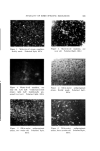
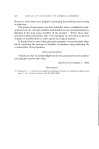
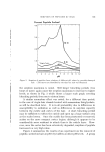
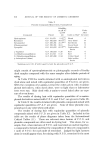
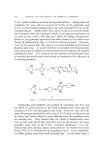
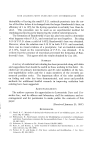
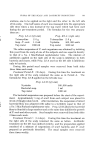
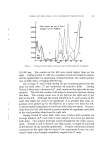
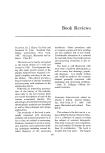
TORSIONAL PROPERTIES OF HAIR Figure 2. Photograph of a hair style produced by setting the waved hair in the front hair line on rollers with water and dry- ing. The detail illustrates the helical arrangement of the style. 577 larity can often be observed by wetting out single fibers of naturally wavy hair and floating them freely on the surface of water in a large container. A similar situation is obtained when one looks at hair just after removal of setting or styling rollers, or after the hair tresses have been set into pin curls and combed out. Here, also, one typically finds the helical coil arrangements, as shown in Fig. 2. These photographs illustrate the tendency to coil formation of hair tresses in setting, as in certain style configurations desired by some consumers. This evidence permits us to assert, therefore, that in several of the very common operations women employ in dealing with their hair it is usual to find the fibers arranged in the form of helices. It is now pro- posed to discuss the behavior of typical helical tresses by examining the characteristics of a mechanical spring for which a good deal of the theory has been developed. _A_ MECHANICAL SPRING MODEL AND FIBER TORSION Classical physics has treated the mechanical behavior of springs (1, 2). The deflection or extension of a helical spring coil under axial loading is generally given by the following equation: KPrSn A = Gd • (1)
Purchased for the exclusive use of nofirst nolast (unknown)
From: SCC Media Library & Resource Center (library.scconline.org)