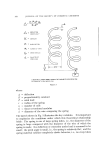
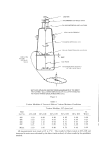
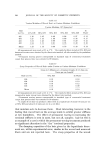
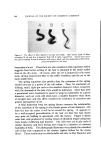
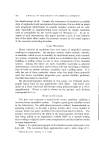
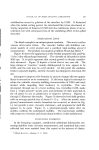
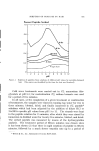
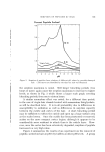
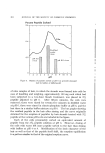
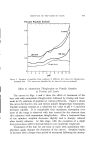
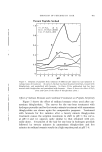
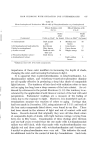
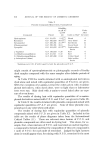
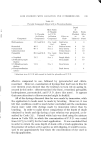
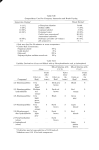
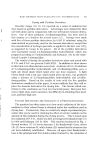
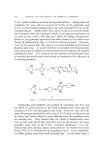
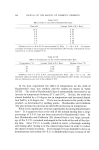
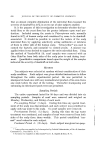
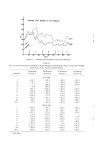
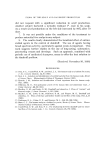
578 where: JOURNAL OF THE SOCIETY OF COSMETIC CHEMISTS K PJ..½ rm //•= G •L 4- t r'- 'j'" A = DEFLECTION UNDER LOAD P K = CONSTANT ,• = RAglLJS OF COIL •r• = qUMBE,ø,OF'F'JR':qS G = SHEAR MODULUS • -- DIA.'4ETER OF .SPRING •1R •'. A MECHANICAL SPRING MODEL SHOWING THE VARIABLES INVOLVED IN THE EXT•N$10N OF A COIL UNDER LOAD. Figure 3 A = deflection K = proportionality constant P = axial load r = radius of the spring n = number o[ coils G = shear or torsional modulus d = diameter of the wire composing the spring The sketch shown in Fig. $ illustrates the key variables. It is important to emphasize the conditions under which this theoretical relationship holds: The spring is one of large spring index, i.e., the diameter of the spring is large compared with the diameter of the wire of which the spring is made the deflection or extension under load is assumed to be small the pitch angle is small, i.e., the spring is relatively flat and the spring matedhal exhibits completely elastic behavior, i.e., no creep takes

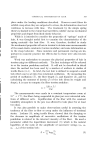
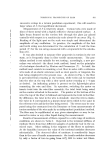
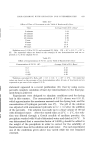
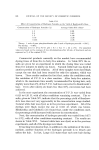
TORSIONAL PROPERTIES OF HAIR 579 place under the loading conditions described. However most fibers do exhibit creep when they are subjected to stress, the deformation observed continues to increase with time. The treatment by the simple spring theory is limited to the extent that hair fibers exhibit viscous mechanical properties and depart from ideal elastic behavior. While it is intended to consider the properties of "springs" made of hair, it was thought useful first to examine the characteristics of the spring material--the hair fiber. It was, therefore, decided to study the mechanical properties of hair in torsion to obtain some measurements of the usual elastic constants (torsion modulus) and some information as to the creep behavior. Since moisture and permanent waving are im- portant in cosmetic practice the effects due to these were also investi- gated. Work was undertaken to measure the physical properties of hair in torsion using two different methods. The first technique will be referred to as the torsion pendulum method. It will not be described in detail since the method has been used by a number of workers in studies of textile fibers (3-5). In brief, the test hair is utilized to suspend a small bob which can be set into free rotational oscillation. By measuring the period of oscillation (T), the fiber length (l), and diameter (d), and by calculating the moment of inertia (I) of the bob (from its weight and shape), it is easy to compute the fiber torsion modulus: 128 ,r I 1 G - T2d4 (2) The measurements were made in a constant temperature room at 21 ø m 1 øC, the fibers being suspended in glass jars over saturated solu- tions of different salts. Equilibration of the fiber with the constant humidity atmosphere in the jars was allowed to take place for at least two days. It was also possible to make observations useful in assessing the tendency of the fiber to flow or creep under the influence of torsional strain. Lochner (6), using textile fibers, showed that the damping or the decrease in amplitude of successive oscillations of the torsion pendulum is related to the internal viscosity of the fiber. He used a parameter called the logarithmic decrement (S) which is the natural logarithm of the ratio of the amplitude of successive swings (a•, a•, aa... a,) of the torsion bob' S = 2.3 log•0 a• (3)
Purchased for the exclusive use of nofirst nolast (unknown)
From: SCC Media Library & Resource Center (library.scconline.org)