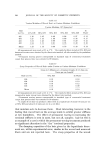
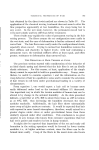
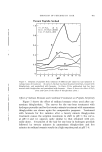
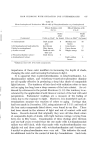
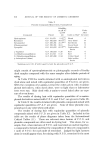
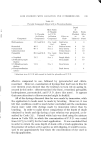
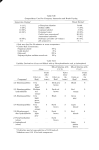
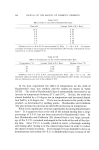
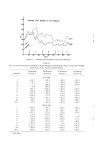
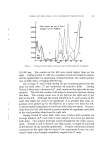
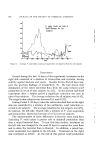
608 JOURNAL OF THE SOCIETY OF COSMETIC CHEMISTS SUMMARY AND CONCLUSION In the case of both hydrogen peroxide and ammonium thioglyeolate, rapid changes in sorption occur in the first five to ten minutes. There is little change in sorption for the next thirty minutes to one hour of treatment with either reagent. After one hour of hydrogen peroxide treatment, peptide sorption becomes progressively greater with in- crease in time. This apparently is true also in the case of ammonium thioglycolate treatment. Oxidizing agents, such as hydrogen peroxide used in bleaching, or sodium bromate used to neutralize ammonium thioglycolate, have relatively little effect in increasing peptide sorption at the highest pH levels but cause sharp increases in sorption at neutral pH values. The use of ammonium thioglycolate alone has less effect on promoting sorption at neutral pH values than at the higher pH levels. It is concluded that the cuticle is destroyed rapidly by the re- agents used, with the swdling and opening up of the cuticle being responsible for the rapid uptake of peptide at this stage. Further chemical treatment removes the cuticle, leaving a cortex which is considerably more resistant to chemical action. Sharply increased peptide sorption occurs only after the oxidation or thioglycolate treat- ments have damaged the hair extensively. ACKNOWLEDGMENT The authors wish to acknowledge the assistance of Elliot Silber and Maxine McCutcheon during the course of this investigation. (Received November 30, 1966) REFERENCES (1) Karjala, S. A., Williamson, J. E., and Karler, A., Studies on the substantivity of collagen- derived polypeptides to human hair, J. Soc. Cosmetic Chemists, 17,513-524 (1966). (2) Karjala, S. A., Bouthilet, R. J., and Williamson, J. E., Some factors affecting the sub- stantivity of proteins to hair, Proc. Sci. Sect. Toilet Goods Assoc., 45, 6-7 (May, 1966). (3) Heiling6tter, R., The swelling and stretching of human hair in solutions of mercapto- compounds, Fette, Seifen, Anstrichmittel, 55,868-871 (1953). (4) Freytag, H., Studies on the physical and chemical properties of human hair. IV. Studies on the phenomenon of wave formation in human hair, J. Soc. Cosmetic Chemists, 15,667-690 (1964). (5) Laden, K., and Finkelstein, P., Studies concerning modification of ionic character of the hair, Am. Perfumer Cosmetics, 81, (10) 39-40, 42 (1966).

J. Soc. Cosmetic Chemists, 18,609 628 (Sept. 16, 1967) Hair Coloring with Oxidation Dye Intermediates HAROLD H. TUCKER, Ph.D.* Presented before the New York Chapter, November 2, 1966 Synopsis--Data on patents for 33 primary intermediates and 20 color modifiers were collected from the literature. The effect of structure on shade, depth of color, light fastness, and solu- bility was determined for each product. The effect on color, depth of shade, and light fast- ness of dyeing mixtures of each of the 20 color modifiers with equimolar quantities of 3 pri- mary intermediates is reported. It is shown that by proper selection of color modifier the shade may be varied, the depth of color greatly increased, the fastness to light increased many fold, and the tendency to turn red on aging decreased. By using the formation of Bandrowski's base from oxidation of p-phenylenediamine as a tool the percentage of conversion to the colored form was shown to be only slightly more than 5% under the conditions normally used for dyeing hair. The effect of various factors on this yield is reported. The results of using five recently described pyridine derivatives are tabulated and dis- cussed. INTRODUCTION Oxidation dye intermediates account for a major share of the hair dye market today. These dyes differ from the usual textile dyes in that, with the exception of the nitro dyes, they are colorless or nearly colorless products which form dyes upon oxidation. According to Heald (1), the intermediates, because of their small size, are able to penetrate into the hair fiber where they undergo oxidation. This converts them into dyes which, because of their increased size, are trapped in the fiber. In other words, during the use of the oxidation dye intermediates, dye manufac- turing occurs within the hair fiber. * 14 Chesterfield Road, Scarsdale, N.Y. 10583. 609
Purchased for the exclusive use of nofirst nolast (unknown)
From: SCC Media Library & Resource Center (library.scconline.org)