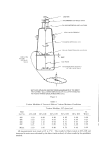
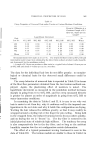
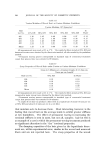
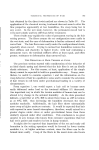
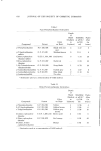
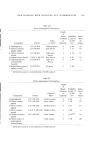
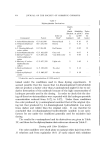
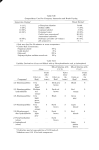
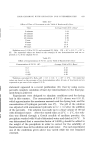
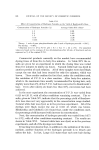
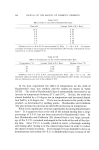
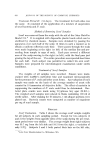
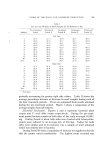
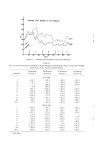
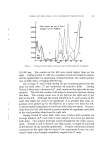
Table XII Compositions Used for Company Immersion and Brush Dyeing Immersion Dyeing a Brush Dyeing a 0.11% 0 20% l0 00% 40 00% ß . ß . 5o 00% 97 p-Phcnylcne diamine Varied Sodium sulfite 0.20% Isopropyl alcohol 5.00% Deionized water 14.00% Cook's base concentrate b 26.00% Ammonium hydroxide 5.00 • Hydrogen peroxide (20 volume) 50.00% pH adjusted to 9.7 Hair was dyed for 30 minutes at room temperature. Cook's Base Concentrate: Propylene glycol 100 g Cetyl alcohol 20 g Oleic acid 300 g Polyoxyethylene sorbitan monoleate 100 g Table XIII Pyridine Derivatives Alone and Mixed with p-Phenylenediamine and p-Aminophenol Compound Mixed Solution with Mixed Solution with Alone P.P.D. P.A.P. Color on Hair a Fades Fades Fades After After After (in Color on (in Color on (in hours) Hair b hours) Hair • hours) 2,3-Diaminopyridine 2,5- Diaminopyridin e hydrochloride 2,6- Diaminopyridine 3,4- Diaminopyridine 2,6-Dihydroxypyri- dine hydrochloride p-Phenylenediamine (alone) p-Aminophenol (alone) Very light blond Medium red orange Very light green blond Very light orange Very light grey ß . , 3 Dark grey 3 Blond 6 brown 6 Dark red 4 Red 5 brown orange 1 Black 2 Green 1 grey Dark 3 brown Dark 3 Brown Dark 4 brown ...... Light 5 blonde Red 9 blonde Light golden brown Derivative used at concentration of 0.025 moles/1. Solutions were 0.01 M in both components.

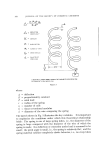
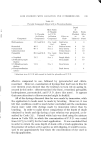
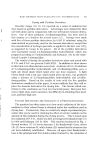
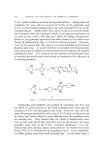
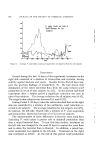
HAIR COLORING WITH OXIDATION DYE INTERMEDIATES 621 Dyeing with Pyridine Derivatives Recently Lange (10, 13, 14) reported on a series of oxidation hair dyes based on pyridine derivatives. Advantages were claimed for their use both alone and in conjunction with the well-known benzene deriva- tives. One of these products, 2,6-diaminopyridine, has been used in this country as a drabber for several years (15). Dyeings were made with five of these pyridine derivatives (in 0.025 M solutions) using the same method as previously used for the benzene derivatives, except that the concentration of hydrogen peroxide, as applied to the hair, was 1.8%, as suggested by Lange in his patent. All of the pyridine derivatives were purchased except 2,5-diaminopyridine hydrochloride, which was prepared according to Tschitschibabin and Kirsanow (16) by the reduc- tion of 2-amino-5-nitropyridine. The results of dyeing the pyridine derivatives alone and mixed with P.P.D. and P.A.P. are given in Table XIII. In addition to those shown in this table two other mixtures were dyed. A mixture of 0.01 M solutions of 2,5-diaminopyridine hydrochloride and 2,6-diaminopyridine gave a light ash blond shade which faded after one hour exposure. A light brown shade with a red east, which faded after one hour, was produced using a mixture of 2,5-diaminopyridine hydrochloride and 2,6-dihy- droxypyridine. Based on the results of tests with the five pyridine derivatives considered in this paper, it seems unlikely that they will re- place the benzene derivatives for dyeing hair. The factors which con- tribute to this conclusion are their low tinctorial power, their poor fast- ness to light alone and in mixtures, the difficulty in obtaining these prod- ucts, and their high cost. FACTORS INFLUENCING THE OXIDATION OF p-PHENYLENEDIAMINE The question has often arisen as to how much oxidation of the inter- mediates to their colored forms is obtained under the conditions used in dyeing hair. Fortunately, there is a relatively simple experimental pro- cedure that can be used for studying the effect of certain variables on the amount of this oxidation during the dyeing process. This is based upon the oxidation of P.P.D., which was first investigated by Bandrowski (17) in 1894 and Erdmann (18) in 1904. This reaction is pictured in Fig. 1. Several workers (17-19) favor structure I for Bandrowski's base, others (20, 21) favor structure II, while Austin (22) states that the structure has not been definitely established. However, all agree that Bandrowski's base is the principal and first stable product formed by the oxidation of
Purchased for the exclusive use of nofirst nolast (unknown)
From: SCC Media Library & Resource Center (library.scconline.org)