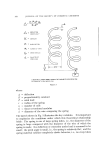
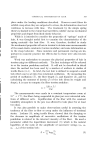
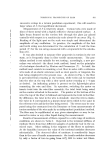
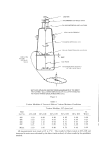
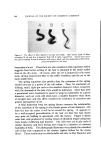
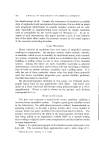
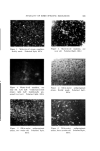
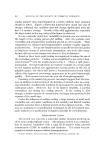
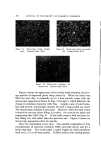
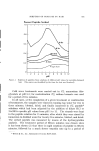
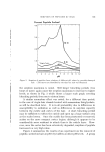
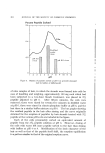
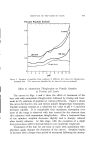
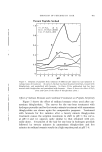
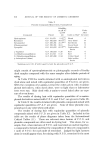
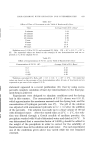
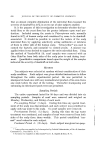
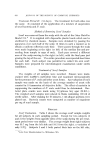
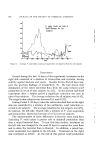
622 JOURNAL OF THE SOCIETY OF COSMETIC CHEMISTS P.P.D. under conditions used for dyeing hair and furs. Heiduschka and Goldstein (23) were able to account for 93.8% of the originally used P.P.D. by determining Bandrowski's base and unchanged P.P.D. in the reaction mixture. Bandrowski's base can be treated as a solvent-soluble dye and used to dye hair a dark grey shade, or an aqueous suspension can be used to dye wool a fast blue-grey shade at boiling temperature. However, it is generally agreed that an azine, formed by the further oxi- dation of Bandrowski's base, is the final coloring material. However, Cox (24) has shown that this azine is even more insoluble in water than Bandrowski's base. It would therefore be included with Bandrowski's base when using an analytical method based on the formation of material insoluble in water. It is evident that the amount of Bandrowski's base or insoluble material formed can be used as a measure of the efficiency of the dyeing operation. NH NH2 • 3 • 0• NH,• NH H2 NH• ¸o 3 ' NH• I NH,• NHz II Figure 1. Proposed structures for Bandrowski's base Heiduschka and Goldstein (23) studied the oxidation of P.P.D. and the effect of various factors on the yield of Bandrowski's base and the amount of P.P.D. left unchanged in the bath. However, they used one mole of hydrogen peroxide for each mole of P.P.D and a treatment time of twenty-four hours, which is vastly different from the conditions used for coloring hair. They showed that the yields of Bandrowski's base were at best only about 30% and that, even in the presence of excess peroxide, some 50% of the P.P.D. remained unchanged. Cox (24) showed that after dyeing copper moralanted fur for twenty-four hours about 15% P.P.D. remained in the unoxidized state. These conditions, too, differ greatly from those used in dyeing hair. On the other hand, a

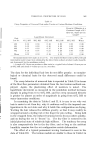
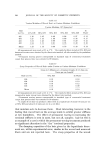
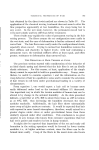
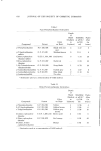
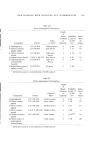
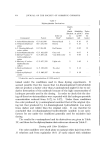
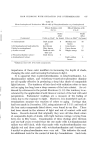
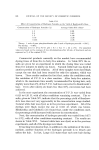
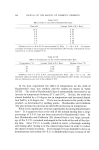
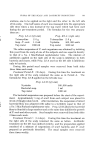
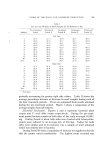
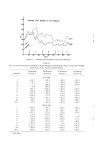
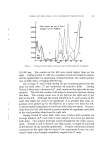
HAIR COLORING WITH OXIDATION DYE INTERMEDIATES Table XIV Effect of 'rime of Treatment on the Yield of Bandrowski's Base Time Average Yield of B.'s Base •' 5 minutes 1 04 623 15 minutes 1 30 minutes 3 45 minutes 5 1 hour 7 2 hours 12 4 hours 17 96 hours 57. 63 00 29 11 2 8 8 a Solutions were 0.1 Min P.P.D. and contained 3% H2Os. PH = 9.7 q- 0.2 T = 25 ø q- 2C. The numerical values are based on the averages of two determinations and are ex- pressed as % of the original P.P.D. Table XV Effect of Concentration of P.P.D. on the Yield of Bandrowski's Base Concentration of P.P.D. (M) Average Yield of B.'s Base a 0.2 5.12 0.1 5.93 O. 05 4.96 O. 025 4.59 a Solutions contained 3% HsOs--pH = 9.7 q- 0.2 T = 25 ø q- 2øC. The numerical values are based on the averages of two determinations after 45 min. of treatment and are expressed as per cent of the original P.P.D. statement appeared in a recent publication (25) that by using excess peroxide complete oxidation of hair dye intermediates to the final pig- ment form is achieved. Experiments were designed to simulate conditions used for dyeing hair in this country. The concentration of P.P.D. chosen was 0.10 M, which approximates the maximum amount used for dyeing hair, and the concentration of hydrogen peroxide was 3%. The pH of the solution was adjusted with ammonium hydroxide to 9.7 + 0.2 after the addition of the peroxide. The solution was made up to a final volume of 100 ml with deionized water. After the stated time at 25 øC + 2 øC, the solu- tion was filtered through a Gooch crucible of medium porosity, the precipitate washed with 50 ml of deionized water and dried at 105 øC. It was determined that a correction factor of 0.0029 g should be added to the weight of the precipitate in order to correct for the solubility of Bandrowski's base in the solution and wash water. For each experiment one of the conditions given above was varied while the rest remained constant.
Purchased for the exclusive use of nofirst nolast (unknown)
From: SCC Media Library & Resource Center (library.scconline.org)