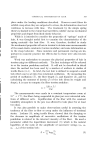
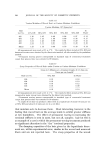
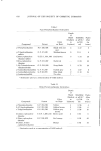
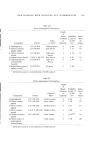
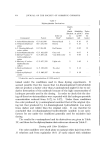
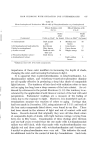
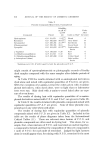
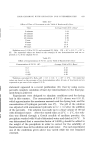
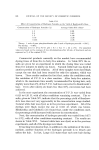
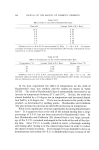
626 JOURNAL OF THE SOCIETY OF COSMETIC CHEMISTS Table XVII Effect of pH on the yield of Bandrowski's Base Final pH Average Yield of B.'s Base a 10.0 99 98 96 93 70 57 5.54 5.87 6.52 6.11 4.75 2.26 O. 59 a Solutions were 0.1 M in P.P.D. and contained 3% H202. T = 25 -k 2øC. The numeri- cal values are based on the averages of two determinations after 45 min. of treatment and are expressed as % of the original P.P.D. Table XVIII Effect of Temperature on the Yield of Bandrowski's Base Temperature (øC) Average Yield of B.'s Base a Melting Point (øC) 25 5.03 236 35 9.83 236 50 18.9 237 a Solutions were 0.1 M in P.P.D. and contained 3% H20•. pH = 9.7 =k 0.2. The numerical values are based on the averages of two determination after 45 min. of treatment and are expressed as per cent of the original P.P.D. In the next experiment the effect of temperature on the yield of Bandrowski's base was studied, and the results are shown in Table XVIII. The yield of Bandrowski's base is substantially increased by an increase in temperature between 25 øC and 50 øC. In fact, the yield was almost doubled by a 10-degree rise in temperature and increased almost four fold by a 25-degree rise. There was no decrease in the purity of the product, as determined by melting points. Heiduschka and Goldstein (23) also obtained an increase in yield with an increase in temperature. What is the significance of these experiments involving Bandrowski's base? It is apparent that at the end of the normal dyeing time a large percentage of P.P.D. has not been converted to Bandrowski's base. In fact, Heiduschka and Goldstein (23) showed that a very large percent- age of the P.P.D. remained unchanged in the bath at the end of the dye- ing time. Since P.P.D. is readily soluble in water, a thorough washing and rinsing after dyeing is of the utmost importance in order to reduce the chance of toxic reactions. Even though it is not desirable to have an instantaneous conversion of P.P.D. to Bandrowski's base, because of the

HAIR COLORING WITH OXIDATION DYE INTERMEDIATES 627 desirability of having the small P.P.D. molecule penetrate into the cor- tex of the fiber before it is changed into the larger Bandrowski's base, an efficiency of 5 to 10% for the dyeing operation is certainly less than de- sired. This procedure can be used as an experimental method for studying practical ways for improving the yield of colored procucts. The formation of Bandrowski's base has also been used to determine what happens when P.P.D., and resorcinol are used together. By using 0.10 M P.P.D. alone a yield of 5.03% Bandrowski's base was obtained. However, when the solution was 0.10 M in both P.P.D. and resorcinol, there was no visual evidence of a precipitate but an insoluble residue of 0.10%, based on the concentration of P.P.D., was obtained. It is evident that the presence of resorcinol prevented the formation of Ban- drowski's base. This agrees with the results obtained by Cox (26). SUMMARY A survey of oxidation hair coloring has been presented along with data and suggestions that should be useful to those working in this field. In- cluded are 33 primary intermediates and 20 color modifiers of the ben- zene-naphthalene series and the 5 main members of the recently an- nounced pyridine series. The important effect of the color modifiers on fading and color has been demonstrated, and areas and possible methods for additional fruitful research in improving oxidation hair coloring have been suggested. ACKNOWLEDGMENTS The author expresses his appreciation to Lowenstein Dyes and Cos- roetics Inc., and its officers and laboratory staff for assistance and en- couragement and for permission to make public the contents of this paper. (Received January 25, 1967) REFERENCES (1) Heald, R. C., Methods of dyeing hair without the use of an oxidizing agent, Am. Per- ruiner, 78, 40 (1963). (2) Wilmsmann, H., Beziehungen zwischen der Molekfilgr6sse aromafischer verbindungen und ihrem Penetrations-verm6gen ffir das menschliche Haar, J. Soc. Cosmetic Chemists, 12,490 (1961). (3) Erdmann, E., Monnet et Cie., French Patent 158,558 (1883). (4) Kass, G., and Hoehm, L., Color reactions of oxidation dye intermediates, J. Soc. Cos- metic Chemists, 12, 148 (1961). (5) Forster, R. D., and Soyka, C., Fur dyes oxidation and identification, J. Soc. Dyers Colourists, 47, 108 (1931).
Purchased for the exclusive use of nofirst nolast (unknown)
From: SCC Media Library & Resource Center (library.scconline.org)