./. Soc. Cosmetic Che•nists 21 205-220 (1970) ¸ 197o Society of Cosmetic Chemists of Great Britain The mixing and blending of powders P.J. LLOYD,* P. G. M. YEUNG*t and D. G. FRESHWATER* Presented at the symposium on "Powders", organised by the Pharmaceutical Society of Ireland and the Society of Cosmetic Chemists of Great Britain, at Dublin, on 17th April 1969 Syn0psis--EXPERIMENTAL results obtained when FREE FLOWING GRANULAR material is rotated in a horizontal DRUM MIXER are presented. The MIXING of compon- ents of similar size and density can be characterised by a parameter, named the MIGRATION COEFFICIENT. This coefficient is used to indicate a SCALE UP procedure. The SEGREGA- TION which occurs when different PARTICLE sizes are present is investigated for a number of different sized drum mixers. The occurrence of an apparently randomised mixture, ob- tained when the drum is rotatd at the speed at which the POROSITY 'of each component is a maximum, is reported. INTRODUCION Powder mixing and blending has been an operation vital to many industries for hundreds of years. It is surprising, therefore, that there have been very few attempts to make more systematic the choice of the type of mixer that is best suited for the most effective mixing of powders. It is well known that powders of which the majority of particles have a diameter greater than about 400 pm will flow easily with the particles behaving as separate entities, whereas when the proportion of particles below about 100 pm increases so does the difficulty in persuading the powder to flow. This transition is due to the increase in importance of surface forces when compared with the inertia forces, i.e. mass or size dependent forces. There is therefore a natural break in the properties of powders. Powders can be thought of as free flowing where particles behave as separate entities or as cohesive where the particles are attached to loose agglomerates. Clearly, *University of Technology, Loughborough. •Present address: University of Missouri, U.S.A. 2O5

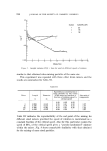
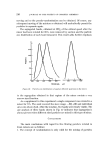
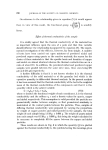
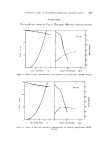
206 JOURNAL OF THE SOCIETY OF COSMETIC CHEMISTS the division between these two classes is not well defined as it can depend on both physical (density etc.) and chemical (surface activity) properties of the particles. It can also depend on the moisture content of the material, e.g. sand when dry flows very easily but if water is added, the wet sand mixture will be very cohesive. A recent survey (1) of all the experimental results published up to the end of 10137 covering 60 papers showed that there had been 33 investigations into material of which the major component had a particle size greater than 400 [tm, 23 where the major component had a particle size between 1130 and 400 I•m and merely three investigations where the particle size was less than 100 [tm. This survey showed the need for more work to be done using components where the particle size is small and the powders cohesive. The survey also showed that the majority of investigations concerned free flowing powders, where the components being mixed had similar particle size and size distributions and that the phenomena of segregation which will occur when particle size differs, had not been studied in depth. This paper reports an experimental investigation into this class. THE MIXING OF FREE FLOWING MATERIALS Powder mixes are frequently assessed by removing spot samples from the mix by means of a thief sampler. If the samples are analysed and the between sample variance S2 of component A is calculated where: S2: •(Pi -- •2 where • is the mean concentratsamplethi N Pi is concentration of and N is number of samples When mixing components of which the particle size is similar, a graph of log S2 v t is linear until a certain minimum value of log S2 is obtained further results oscillate about this minimum value (Fig. 1). Such results have led many workers to make the following conclusions, either implicitly or explicitly: 1. The mixing process is always analogous to a first order reaction from which the mixing rate is easily deduced. 2. The mixing of powders is a process similar to that of the mixing of liquids, and so a law analogous to Fick's second law of diffusion applies. •p c•2p -- D . where a diffusion coefficient D can be •t 8x 2 assigned to the mixing process.
Purchased for the exclusive use of nofirst nolast (unknown)
From: SCC Media Library & Resource Center (library.scconline.org)