256 JOURNAL OF THE SOCIETY OF COSMETIC CHEMISTS reported here, however, we mixed the glycerol and water in the proportions required, then stirred in the Laponite with a high speed stirrer. MR. J. M. BLAKEWAY: Do you have any intention of producing these materials as organic modified bentones? DR. NEUMANN: We are hoping to start production soon. MR. A. Mogs: According to Carless and Nixon (4) soluble fluoride was less than 1.5% in Laponite. Is your product non-toxic and suitable for internal use? De. NEUMANN: As always happens in the development of any new product, early tests are done on material which is later improved. When we gave samples to Prof. Carless and Dr. Nixon we had a material which contained fluoride. Since then we developed a material which contains no fluoride at all, soluble or insoluble. Had Prof. Carless started his work two years, rather than three years ago, he would have had this new material from us. (We have had Dunlop Committee approval for internal use since the meeting.) DR. J. J. MAusN•.R: What is the effect of uv light on these gels? DR. SANSOM: We have not studied the effect of uv radiation on Laponite gels, but with the system we have, it is difficult to foresee that there would be any problem. MR. J. B. W•LK•NSON: Clearly these types of clays are surface active because you can make various exchange reactions take place at their surfaces. Do they give any problem in long-term storage with reactive groups, for instance in the presence of various types of alcohols? Will the nature of the gel change with time because you are actually getting surface reactivity? DR. NEUMANN: NO change is expected to take place with alcohols. Ion exchange reactions can be expected if the system contains amine groups or other cationic com- pounds. If the cation is large, the ion exchange tends to be irreversible, so I would watch the stability of these systems. Me. A. FOSTER: Have you any data on the long-term effect of high shear rates or other mechanical action on these gels as regards eventual recovery of yield values? De. SANSOM: The gels are thixotropic. They will break down with the application of high enough shear, and reform on standing. This property is not lost when the gels are left standing for many months. DR. NEUMANN: Just to add to this--we have found that the application of really high shear rates (18 000 s-•) does not destroy the thixotropic properties, or lower the final gel strength. Me. S. J. STRiA•-s•.: Do you have any experience in making rigid gel structures with Laponite? (4) Carless, J. E. and Nixon J. R. Some applications of rigidity and yield values in a study of gelatin and Laponit• gels. J. Soc. Cosmetic Chemists gl (1970) in the press.

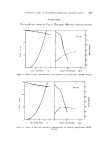
LAPONITE CLAY--A SYNTHETIC INORGANIC GELLING AGENT 257 DR. NEUMANN: This is just a question of concentration. The higher the concentra- tion of Laponite, the higher the rigidity. We could not handle mixtures of higher concentration than 5% Laponite, because they become so stiff that our mixing equip- •nent could not cope. If we had used a colloid mill or a Zed blade mixer, we could have made some rigid gels. Ma. A. Moils: The disadvantage of clays is the slow rate of swelling of colloidal particles. Wood, Catacalos and Lieberman (5) found that it took six months to achieve complete swelling in a 5% Veegum dispersion. Have you studied the swelling rate of Laponite? DR. NF•UMAN•: If Laponite is mixed with a polar organic compound and water added, equilibrium is reached quickly. Even when the clay is added to the solvent- water mixtures, equilibrium conditions are reached in less than a day. One of the differences between natural clay and Laponite is that the latter has smaller crystallites and consequently larger surface area. Dispersion is more rapid if more surface is exposed to solration. MR. M. J. I(oo'r: We have used both heat and high stress for swelling Laponite- type clays. Could you comment as to which is the best method? DR. SANso,a: If the application of heat is possible, the dispersion is faster at higher temperature, as with all clays. However, Laponite is quite easy to disperse in cold water with high shear mixing. MR. R. H. McDowEI•I•: Presumably the Laponite gels have a true static yield value, below which an applied shear stress does not decay with time. Have you measured this, and if so, how does it compare with the extrapolated stress value? DR. N•u•I•N•: The true static yield value is, of course, lower than the extrapolated shear stress. We have not measured it accurately, but have estimated it by a simple bottle inversion test. The gels were stored in approx. 75mm diameter bottles, and inverted after 16-24 h. If they did not flow, they were given a "pass" tnark. DR. SaNsoM: We have recently acquired a Weissenberg rheogoniometer and so the yield value can be studied at very low shear rate. As shown by Carless and Nixon (3), it is difficult to estimate a static yield value with the Ferranti-Shirley viscometer. MR. J. M. B[a}c•wa¾: Reverting to Mr. Watson's question. I wonder whether the problem with toothpaste might not be calcium ions reacting with the clay? DR. SA•so•: It could be - it depends on the concentration. MR. J. W. CI•im, t•a•aI•F,: I should like to revert to Mr. Watson's contribution concerning the rate of formation of gel structure of the glycerol-water-Laponite system, and would like to supply some more detail. I should be grateful for your (5) Wood, J. H., Catacalos, G. and Lieberman, S. V. A rheological study of the aging of Veegum suspensions. f. Pharm. Sci. õ9. 354 (1963).
Purchased for the exclusive use of nofirst nolast (unknown)
From: SCC Media Library & Resource Center (library.scconline.org)