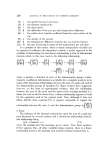
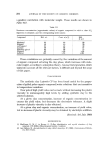
262 JOURNAL OF THE SOCIETY OF COSMETIC CHEMISTS t)harmaceutical tablets this unit of scrunity, therefore, consists of a single tablet. Train (4) in making this point, showed the errors that may arise in taking 20 or even 80 tablets for the assay sample. Thus a 10% variation of a sample of 20 tablets may mean a 40}/0 variation between individual tablets and for a sample of 80 tablets, this individual variation could be as high as 90%. However, before deciding on this unit of scrutiny the purpose of the sampling must also have been considered. In the example quoted, in order to determine the variation between individual doses, single tablets must be taken for individual samples. If the purpose of the sampling was to measure the mean content of drug in the tablets then samples of 80 tablets or even more should be taken and the bulk assayed. Where this bulk is large com- pared with that necessary for analysis it may be necessary to divide the sample. This may be achieved by dissolving the whole sample and taking an aliquot portion for analysis, but where this is not possible, care must be taken to ensure a correct division of the sample by size reduction of the component particles. When sampling cosmetic powders, an area of scrutiny suggests itself as a more probable unit, since the powder mixture will probably be used as a thin film of just a few, at most, particles in depth. The problem here is to avoid agglomerates of either pigment or diluent particles that would be shown by the so called "draw-down" test. Agglomeration of single com- ponents effectively reduces the number of particles, N, in the spot sample giving a larger measured coefficient of variation in the Poole, Taylor and Wall diagram. It may be necessary to overcome such tendencies towards agglomeration by using mixing machinery which also incorporates features bringing about size reduction in the preparation of such powder mixtures as described by Brock {5). ASSESSMENT OF POWDER MIXTURES In order to assess the powder mixtures, a number of mixing indices have been proposed. The basis of the majority of these involves the comparison of the measured standard deviation of sample concentration {s) with the estimated standard deviation of a completely randomized mixture Allowance may also be made for the standard deviation of a completely unmixed system (•o)' The utility of the standard deviation of the ran- domized mixture has been extended to mixtures of non-uniform powders by the Poole, Taylor and Wall (2) modifications to the formula of Stange (6)

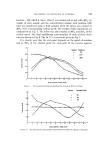
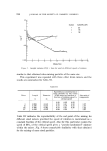
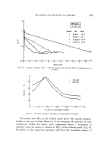
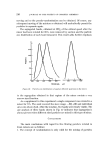
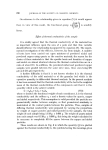
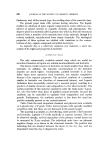
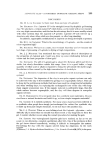
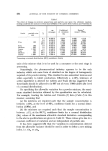
SAMPLING AND ASSESSMENT OF POWDER MIXTURES 263 xy/ M Y(•"fw) x 4-X(•-fW)y where 5[ is the mass of the sample taken from the mix and Efw is the effective mean particle weight of mix component. Amongst the indices proposed, mention might be made here of s/o R as used by Poole et al (the reciprocal was also used by Lacey) and of that proposed by Ashton and Valentin (7). 2 log s2 log % A2 : 2 log 2 log c• o c• R It is usually assumed that sample concentrations obey the normal distribution law and that a sufficient number of samples are taken to correctly estimate the true standard deviation of sample concentrations. Since the condition of the randomized mixture is used as the basis for assessing the degree of mixing that has been attained, it is necessary to examine the properties of the randomized mixture. This reveals that the standard deviation of sample concentration depends on the number of particles taken in the sample, or, for a given sample weight, on the particle,- size distribution of the two ingredients and also on the proportions of these ingredients. Ashton and Valentin (7) calculated the effect of change in mixture proportions and particle size upon the ultimate randomized mix condition for mixtures of fine sand (160[tm) •vith calcite (Table I). From Table I it is evident that the coefficients of variation theoreticall 3, attainable decrease •vith increasing concentration of the minor ingredient and with decreasing particle size. Randomized mixtures of coarse particles containing a very small proportion of the minor ingredient cannot really be described as being very homogenous and it might be expected that randomization might be relatively easy to bring about in such a case. The results of Ashton et at (7) in the rate of mixing tend to confirm this finding (Figs. 1 and 3). Since mixing indices based on the randomized state are dependent upon the particle properties of the mixed po•vders as well as the proportions present, an index independent of such parameters might offer a better solution in describing the homogeneity of a powder mixture. Such an index may be based upon some standard specification. When examining powder mixtures as to the variation of sample con- centration, the sample size or scale or scrutiny is established by the smallest
Purchased for the exclusive use of nofirst nolast (unknown)
From: SCC Media Library & Resource Center (library.scconline.org)