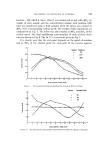
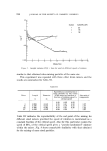
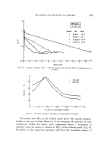
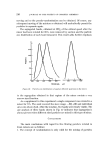
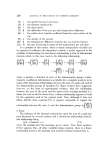
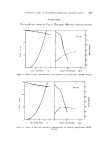
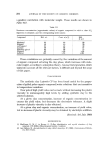
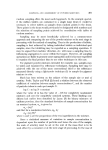
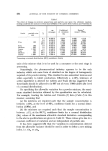
THE MIXING AND BLENDING OF POWDERS 209 influence of the particles and the machine. The first series of experiments was concerned with the mixing of the same sized particles of the same density in drum mixers of different sizes. The second series was concerned with the mixing of the same sized particles but those with slightly differing density and the third series was concerned with the mixing of different sized components. The mixing of toorio~sized particles of the same densit v The general solution for the between sample variance to the equation obtained from the stochastic analogy is S2(t)--_2 11=1 which simplifies to 1 exp [72 (2n--1)2 •c2 Dt)l (V) 412 (2n--l) 2 •2 [ 212 J when only the first term is taken 1, is the length of the drum mixer and D is the migration coefficient, dependent on both the material and the mixer parameters. Graphs of 1 n S2(t) vt yield straight lines from which D can be determined from the slope. A narrow sieve cut[(--36/+52) 355 sieve] of sand was prepared and half the sand was dyed with a proprietary dye. After thoroughly drying the sand was resieved. The experiment consisted of loading the drum end to end with $0% of each component. Samples were taken with a thief sampler at selected time intervals and the proportion of dyed to undyed sand counted manually. The results are presented in Fig. 1. Three different sized drums were used. Their dimensions are shown in Table I which also includes the values of the migration coefficient D obtained from a series of experiments performed at a rotational speed of 0.52 X the critical speed*. A single experiment in mixer II shows the results of an experiment at a lower speed. It would appear from these results that the length of the mixer is satisfactorily accounted for in equation VI and that D is aslowly varying ß *Critical speed is that rotational speed at which the material in the drum just begins to centrifu•e.

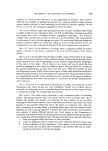
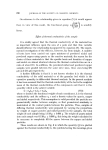
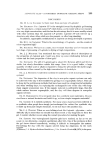
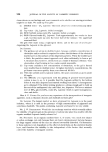
210 JOURNAL OF THE SOCIETY OF COSMETIC CHEMISTS Table I Mixer 1[ III II Length 0.295 o. 15 0.18 0.15 Diameter 1TI 0.145 0.145 0.182 0.145 Rotational speed as fraction of D critical speed x 10_2m2 s_l 0.52 0.0257 O. 0261) 0.0257 0.52 0.0254 0.52 0.0272 0.33 0.0295 parameter in terms of the speed of the drmn and the diameter of the drum. Thus if the mixing process is considered to proceed from the completely segregated case to the fully randomised situation it is possible to predict the time of mixing required in any sized mixer from a single experimental run viz:- (1) cmnpletely segregated mixture has a variance (2) 2 o --- p{1--p) o (2) completely randomised mixture has variance 2 p(1--p) R n (3) rate of mixing will be 212 (4) thus the optimum time of mixing will be from Fig. 2. 2 2 t = lna ln• o R k This time will be longer than the nfinimum time since no account has been taken of terms other than the first in equation V and also it is assumed that the loading of the components is the worst possible state, i.e. completely segregated. Nevertheless, it is seen that this technique gives one the possibility of transferring the results obtained in a small tumbling mixer, where experiments can be carried out quickly, to a full scale mixer with some confidence.
Purchased for the exclusive use of nofirst nolast (unknown)
From: SCC Media Library & Resource Center (library.scconline.org)