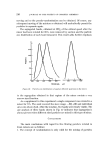
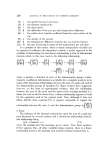
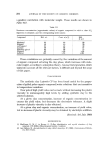
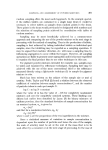
THERMAL CONDUCTIVITY EFFECTS IN THE DIFFERENTIAL THERMAL ETC. 229 This relationship has been investigated and the results suggest that equation {VI) is not always applicable in practice. With these points in mind, therefore, the experimental data will now be considered. EXPERIMENTAL RESULTS Effect of sample size Various workers have suggested and, in fact, it appears reasonable to believe that the area of the peak is proportional to the quantity of reactive material present. A number of tests have been carried out to investigate this relationship and the result is shown in Fig. $. It is seen at once that the result is an extremely good linear relationship. Hence it appears safe to accept that, all other conditions being maintained constant, the area of the peak is proportional to the mass of material undergoing reaction. ISO '.' o 20 '"/ ' ' TEST MATERIAl.OOARTZ o o.• o.• o.3 o• o.s o.• MASS OF REACTIVE Figure

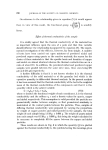
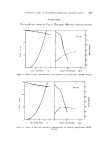
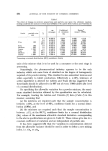
230 JOURNAL OF THE SOCIETY OF COSMETIC CHEMISTS On reference to the relationship given in equation (V) it would appear that, in view of this result, the functional group q01• eO2• is sensibly linear. Effect of thermal conductivity of the sample It is widely agreed that the thermal conductivity of the material has an important influence upon the area of a peak and that this variable should influence the relationship is supported by equation (V). The experi- mental investigation of the effect is, however, far from simple. A number of tests have been carried out upon mixtures of powdered nickel and powdered copper using quartz as the reactive material the reason for the choice of these materials is that the specific heats and densities of copper and nickel are almost identical whereas the thermal conductivities are in a ratio of about 13:1. In addition, the powdered nickel and powdered copper samples were graded between the same sieve sizes, these sizes being 251 gm and 211 gm respectively. A further difficulty is that it is not known whether it is the thermal conductivity of the solid material or of the granular bed which is the operative quantity in differential thermal analysis. In the present analysis it has been assumed that the thermal conductivity of the bed is the weighted mean of the thermal conductivities of the components and that it is this quantity which is the salient variable. k = wqkq q- wckc q- wnkn (VI I) where w denotes the fractional weight of each constituent, k is the thermal conductivity and the suffixes q, c and n denote values for quartz, copper and nickel respectively. This assumption is valid provided the particles are geometrically similar between samples, so that geometrical similarity is maintained at the contact points between the particles. Thus, samples of differing thermal conductivity were prepared by varying the proportions by weight of copper powder and nickel powder in the samples, the total weight of each sample being 1.119 g + 0.001 g. The weight of quartz mixed into each sample was 0.119 g + 0.001 g, this being the weight calculated to be necessary to completely fill the spaces between the copper and nickel particles. These results are shown in Fig. 6 in which the quantity Q/A is plotted against the thermal conductivity k, the symbols having the meanings given
Purchased for the exclusive use of nofirst nolast (unknown)
From: SCC Media Library & Resource Center (library.scconline.org)