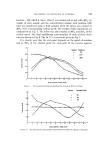
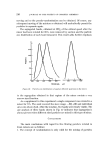
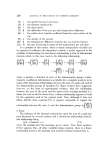
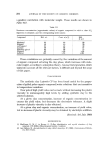
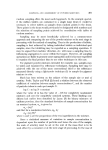
242 JOURNAL OF THE SOCIETY OF COSMETIC CHEMISTS It is seen that the OD values are low, i.e. the dispersions are clear up to a fairly high concentration, and then suddenly increase. There is even a slight and unexpected improvement of clarity at low concentrations of organic compound. The ESS values increase up to a sharp peak which corresponds to the sudden onset of cloudiness. The three alcohols tested show a small dip at low concentration before the values begin to rise. elhonol 5o Ethanol _ 100 0 50 -- -- Iso propanal .... _. i oo o 50 Acetone ioo o .50 30 - 50 0 - 60 - 70 I00 Concentrohon of organic compound, % 150 / 1oo Ethylene glycol Sarbdol 50 •00 Glycerol o 5o IOO 0 5i0 0 --I0 -- 20 -- 40 .-- - 50 0 -- 60 -- 70 0 0 Concentration of argoinc compound, % Figure 1. Elfcot of concentration o[ various organic compounds on the ESS and optical density of 2 • Laponite CP dispersion.

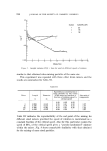
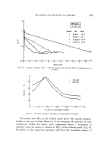
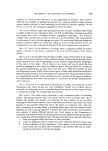
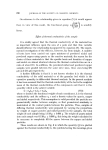
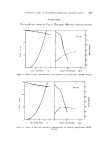
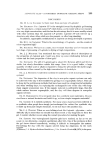
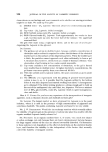
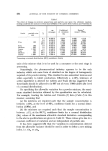
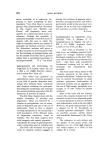
LAI'ONITE CLAY--A SYNTHETIC INORGANIC GELLING AGENT 243 The concentrations selected for further work are shown in Table 11. Table I [ Solutions of polar organic compounds studied Organic compound Methanol Ethanol isoPropanol Acetone Ethylene glycol Glycerol Sorbitol % (w/w) 40 and 25 40 and 25 40 and 25 40 50 •0 5½ Two different concentrations of the alcohols were used. The 40% con- centration selected according to the original plan was found to be too sensitive to electrolyte, so the work was repeated at 215%. The results obtained on the various systems are discussed individually. Methanol/water ( raphs for the 25% and 40% methanol systems are shown in Figs. and $. 150.• 0 ioo z • •o 2_%cloy -- I • I I Z 3 4 5 0 0-5 1.0 Clay concentration, % Sodium concentration, me Figure 2 Effect of clay and electrolyte concentration on methanol/water (25/75) systems 3o 4o 5o •- o. o 6o 7o
Purchased for the exclusive use of nofirst nolast (unknown)
From: SCC Media Library & Resource Center (library.scconline.org)