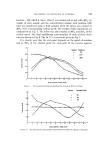
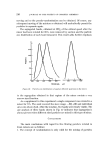
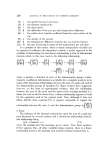
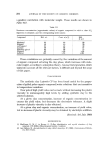
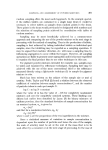
THER3IAL CONDUCTIVITY EFFECTS IN THE DIFFERENTIAL THERMAL ETC. Figure 2a '['• M oe Figure 2b upon the measurement of the area of the peak. An idealised form of a peak on a thermogram is shown in Fig. 2a and the form of the thermogram more often obtained in practice is shown in Fig. 2b. Considering Fig. 2a, it is clear that the reaction will be completed at point X somewhere between the points B and C since, however, the point X is not usually revealed on the thermogram it is usual to consider points A and C as marking the onset and completion of the reaction, respectively. Hence, the line AC is taken as the line which defines the base of the peak. For the thermogram more usually obtained in practice {Fig. 2b) the points which mark the

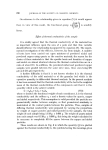
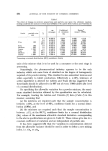
224 JOURNAL OF THE SOCIETY OF COSMETIC CHEMISTS onset and completion of the reaction are less easily determined. In con- sequence, the line which forms the base to the peak cannot be accurately defined. The effect of this situation is that a great number of methods of defining the area of a 15eak have been suggested but all these methods appear to be completely empirical. Furthermore, there appears to be no theoretical justification for the assumption that the base to peak is a straight line rather than a more complicated curve. It is, therefore, necessary to relate experimental data for the area of a peak, defined in some definite, although empirical, manner to the quantity of reactant present and, by use of the knowledge of the calibration characteristic of the instrument, the quantity of the reacting matehal is deduced from the measured area. In fact the area of the peak is not uniquely defined by the mass of reactant present and very considerable care and knowledge is necessary in the calibration of the apparatus. It is with these questions that the present paper is concerned. It will be shown that the particle size and the physical properties of the powder under analysis have an important influence on the relationship between the area of a peak and the mass of reacting material. It will also be shown that the common practice of diluting a sample with an inert refer- ence matehal is one which should be treated with caution. Little theoretical treatment can be offered to explain the observations presented below but it is believed that these observations are of consider- able importance in providing an indication of some of the factors which must be considered when the technique of differential thermal analysis is used for accurate quantitative analysis of powdered materials. APPARATUS The apparatus is a 'Standata' Differential Thermal Analysis equipment, manufactured by Stanton Instrument Co. Ltd., the apparatus being equipped with furnaces which operate at temperatures of up to 1 000øC and with the makers' standard 'Sinfox' block head. Details of the head are shown in Fig. 8. The heating rate adopted for the present work is 10øC min-• and, after an initial period of about 20 rain, this rate is held constant to an adequate degree of accuracy by the electronic control gear. The sensitivity of the recorders is approximately as follows: For the temperature of the sample 25.4 mm = 1.0 mV _• 100øC. For the differential temperatures 25.4 mm=2.5 [tV _•0.2øC.
Purchased for the exclusive use of nofirst nolast (unknown)
From: SCC Media Library & Resource Center (library.scconline.org)