240 JOURNAL OF THE SOCIETY OF COSMETIC CHEMISTS Organic compounds The following were studied:- Methanol Ethanol isoPropanol Acetone Ethylene glycol Glycerol Sorbitol B.P. grade, 100% Industhai methylated spirit, 95% Standard laboratory reagent, 100% Technical grade, 100% May & Baker laboratory chemical, not less than 95% May & Baker laboratory chemical, not less than 95% Howsorb No. 1, 70% Distilled water was used for making up solutions of these, and the concentrations quoted are expressed on a weight basis of the pure organic compound. Electrolyte Sodium chloride was chosen as a typical electrolyte. Work performed with other electrolytes in pure aqueous systems (to be published later) has indicated that there is no fundamental difference between the effects of all electrolytes on clay dispersions. Methods Preparation of dispersions The aqueous solutions of the organic compounds were prepared first, and the sodium chloride, when used, was added to it. The clay powder was then stirred in at room temperature, using a high speed stirrer (ap- proximately 3,000 rev min-1) for about 15 min, until visually dispersed. The dispersions were then allowed to stand for 16-24 h. Rheological properties The rheological properties were tested with a Ferranti-Shirley visco- meter. Details are as follows:- Cone 3.5 cm radius, "36 I•m particle" cone Maximum speed 1000 rev min-1 _-- shear rate of 18,300 s-• Sweep time 60 s Temperature of plate 25øC. The flow curve was recorded after reaching equilibrium by applying an initial up-down cycle. A tangent was drawn to the linear upper portion

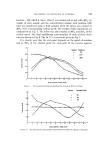
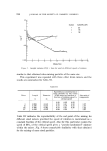
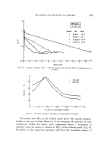
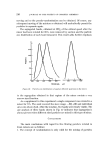
I..•PONITt' CLAY---A SYNTtlETIC INORGANIC GELLING AGENT 241 of the down curve, and the intercept on the shear stress axis was measured. This Extropolated Shear Stress is shown in our results as ESS. While it is understood that this is not a true yield value, it is convenient to refer to it as such. The plastic viscosity (PV) of the dispersion was calculated from the slope of the same line. optical densit3, (O.D.). Since the fully dispersed Laponite CP system is clear and the floc- culated system is very cloudy, it is convenient to follow the course of flocculation by measuring the optical density. This was done on an EEL Absoptiometer, using a 20 mm cell and a Green-Blue Filter No. 603. In some systems, where the viscosity and yield value of the medium were high, the inclusion of air bubbles was unavoidable, and the OD could not be measured. In these cases, the clarity was estimated visually. SCOPE OF THE WORK initially a series of solutions was prepared from each organic compound, and 2% Laponite CP was added. It was found that, as the concentration of the organic compound increased, the dispersions became very slightly cloudy, until a point was reached when further increase caused gross flocculation, i.e. a great increase in cloudiness. For the study of the effects of clay and electrolyte concentration, convenient high concentrations of organic compound that still gave an almost clear dispersion were selected. The clay concentrations were not taken any higher than could be readily measured on the Ferranti-Shirley viscometer. The consistency correspond- ing to the highest values recorded was somewhat similar to that of petrol- eum jelly. There is no reason why higher clay concentrations should not be used, though good dispersion would require the use of high shear mixing equipment. The effect of varying electrolyte concentrations was examined at 2% clay concentration. The trends observed would, of course, be similar at other clay concentrations. RESULTS The results of the preliminary investigation in which the concen- trations of organic compounds were varied at 2% clay concentration are shown in Fig. I. On these, as on all following figures, the ESS and OD values are plotted on the same graph.
Purchased for the exclusive use of nofirst nolast (unknown)
From: SCC Media Library & Resource Center (library.scconline.org)