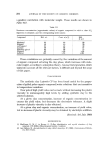
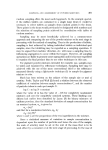
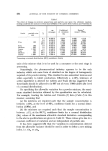
254 JOURNAL OF THE SOCIETY OF COSMETIC CHEMISTS a positive correlation with molecular weight. These results are shown in Table VII. Table VII Maximum concentration (approximate values) of organic compound in which a clear dispersion is obtained, and the corresponding yield values:- Compound Mol. wt. Conc. w/W•o ESS Nm-2 Methanol Ethanol isoPropanol Acetone Ethylene glycol Glycerol Sorbitol 32 46 60 58 62 92 182 4O 4O 45 55 55 60 70 23 30 32 47 17 55 231 These correlations are probably caused by the variations of the amount of organic compound solvating the clay phase, which increases with mole- cular weight, according to adsorption theory. An exact interpretation, which takes into account all the relevant factors, is difficult and beyond the scope of this paper. I•ONCLUSIONS The synthetic clay Laponite CP has been found useful for the prepar- ation of gelled polar organic compound/water solutions that are insensitive to temperature variations. Clear gels of high yield value can be made without increasing the plastic viscosity to unmanageably high levels by adding synthetic clay to the selected solution. At a given clay concentration, increase of organic concentration in- creases the yield value, but decreases the electrolyte tolerance. A slight increase of plastic viscosity is also obtained. At a given clay and organic concentration, an increase of yield value, but no increase of plastic viscosity may be obtained by electrolyte addition. (Received: 3rd July 1969) REFERENCES (1) MacEwan, D. M. C. in Brown, G. X-Ray identification and crystal structures of clay minerals. 176 (1961) (Mineralogical Society, London). (2) van Olphen, H. An introduction to clay colloid chemistry, 47 (1963). (Interscience Publish- ers, Nexv York).

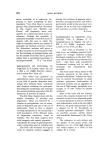
LAPONITE CLAY--A SYNTHETIC INORGANIC GELLING AGENT 255 DISCUSSION 51R. 5I. G. •_: NAVARRE: IS there more than one type of Laponite? DR. NEU•AN•: Yes. Laponite CP is the straight-forward hydrophilic gel-forming clay. We also have a version named SP which forms a sol in water with a low viscosity at a very high concentration, and this has the advantage that it is more readily mixed with other systems than the Laponite CP powder. Laponite SP sols will set up a structure only when other solids are also present, or after long standing. I n addition, organophilic modifications of Laponite are being developed at present. MR. M. G. DE NAVARR•: What is the microbiology of Laponite - are the counts of micro-organisms high? DR. Nr U•AN•: We have no counts, but we think that they are low because the last stage of processing of Laponite is drying at high temperature. DR. J. J. MAUSN•R: You mentioned the very important effect of electrolytes on the properties of Laponite gels. Could you draw up some relationship between pH values and the basic properties of these gels? DR. NEUMANN: The pH of Laponite gel is about 8.3. Between pH 6 and 12 it is stable, but slowly flocculates outside this range. Since it is a good buffer, a large quantity of either acid or alkali is required to bring the pH outside the stable range flocculation is then caused by the high concentration of electrolyte. DR. ]. ]. MAUSNER: Could these systems be modified to work in non-polar organic systems? DR. N•u•: The dispersion of the clay in non-polar organic systems can only be achieved if the clay is first modified by giving it an organophilic surface. This can be done by the well-known methods that have been used for a long time for bentonires and other swelling clays, by replacing the exchangeable ions of the clay with long- chain organic ammonium ions. If the organic molecule is sufficiently large, then the whole surface becomes organophilic, and the clay will then disperse in non-polar organic solvents. D•. R. M•c}•so•o: It is not quite clear how synthetic your material is. Do you start from a natural hectorire and build it up, or from simple inorganic materials? DR. S•so•: It is entirely synthetic. For many years clays have been referred to as synthetic when people have simply just exchanged the cation. Our synthetic clay is made up from pure simple chemicals, we do not start with another clay. MR. C. A. W•so•: When we were talking about the Laponite - glycerine - water difficulty {8), it seems that our trouble was that it took a very long time to form the gel. I wonder whether we are using the correct procedure for making the gels. DR. SANsoft: Our water-glycerol-Laponite gels have reached, as far as we are aware or can determine, complete equilibrium after 24 h. One of the problems is that the gel forms almost immediately, making it difficult to homogenise the system. Pre-wetting the clay with the organic solvent helps the dispersion. In the work (3)•ratson, C. A. Hyd, ocolloidsand dentifrices. J. Soc. Cosmetic Chemists • (1070) in the press .
Purchased for the exclusive use of nofirst nolast (unknown)
From: SCC Media Library & Resource Center (library.scconline.org)