j. Soc. Cosmetic Chemists 21 221-235 (1970) ¸ 1970 Society of Cosmetic Chemists of Great Britain Thermal conductivity effects in the differential thermal analysis of powdered materials j.E. ENGLISH* Presented at the symposium on "Powders", organised by the Pharmaceutical Society of Ireland and the Society of Cosmetic Chemists of Great Britain, at Dublin, on 17th April 1969 Synopsis--The influence of the physical and thermal properties of powdered materials upon the results of DIFFERENTIAL THERMAL ANALYSIS is of considerable importance when an accurate quantitative analysis is required. The effect of the PARTICLE SIZE and the range of particle size of a powdered sample upon the area of a peak of a thermogram has been investigated and, whilst it appears that variations in mean particle size have little effect, the influence of the range of particle size upon the area of a peak can be considerable. The influence of the thermal properties of POWDERED materials upon a THER19IO- GRAM are also discussed and an EXPERIMENTAL relationship between the area of peak and the thermal conductivity of the particulate bed has been determined. These data suggest that the technique of sample dilution must be used with great caution, since the thermal conductivity of the sample is changed by the addition of the dilutant and this change in the thermal conductivity affects the area of a peak of a thermogram. INTRODUCTION The technique of differential thermal analysis is now widely used in connection with the determination of the composition of a considerable number of materials and the identification of structural changes, these structural changes giving considerable information as to the composition of a material. For qualitative purposes the technique is reasonably satis- factory but for the purposes of accurate quantitative analysis the existing *Faculty of Engineering, King's College, London W.C.2. 221

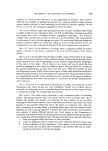
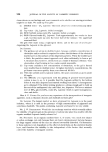
222 JOURNAL OF THE SOCIETY OF COSMETIC CHEMISTS state of knowledge is far from satisfactory and the treatment of results obtained by this technique is empirical. It will be recalled that in this technique a sample of the material under test and a sample of an inert reference material, the samples being of equal weight, are placed in matched platinum crucible• which are heated in a furnace. The heating rate of the furnace is controlled to produce a uniform rate of rise of temperature in the furnace. The temperature difference between the test sample and the reference together with the absolute temperature of the test sample are measured by means of a pair of thermo- couples, the arrangement of which is shown in Fig. 1. •EFERENCE SAMPLE COLD •JuNcTIONS, Figure l Platinum ----- Platinum-rhodium ...... Copper When the sample under analysis undergoes a structural change the heat associated with this change produces a temperature difference between the test sample and the reference sample. This difference in temperature is recorded as a peak on the differential temperature curve. The linear rate of rise of temperature of the test sample is also usually recorded. The tempera- ture of the sample at which the peak occurs provides a means of identifying the reacting material in the sample, and the area of the peak is a measure of the mass of reactant and of the heat of reaction. From the foregoing des- cription it follows that quantitative differential thermal analysis depends
Purchased for the exclusive use of nofirst nolast (unknown)
From: SCC Media Library & Resource Center (library.scconline.org)