260 JOURNAL OF THE SOCIETY OF COSMETIC CHEMISTS Whilst the actual operation of powder mixing is tremendously important, it is not considered within the scope of this paper. Many misconceptions exist and problems arise which may be attributed to incorrect sampling or to erroneous assessment in the quality control of powder mixtures. This paper attempts to cover this field with special reference to the pharma- ceutical industry, where possible similarities or differences with the cosmetic industry are made. SAMPLING OF POWDER MIXTURES The sampling of a powder mixture is a complex problem about which much has been written. The number of samples to be taken, the size of each sample, the purpose of the sample and the method by which they are to be taken must all be considered. The number of samples to be taken depends upon the acceptable sampling error. Sampling is simply taking a number of parts from a mass such that these parts illustrate the qualities of the mass. In order that these samples represent accurately the qualities of the mass it is necessary to divide the mass into a number of parts and examine all of these parts. Such an exercise would clearly defeat the object of sampling which is to examine a relatively small part of the mass and conclude from this examination the qualities of the mass within certain acceptable limits of error. The larger the number of samples taken, the smaller will be the sampling error and this will facilitate more accurate statistical evaluation of the quality of the mass. Where possible variations are known to exist, a sampling plan may be devised to include all such variations. For example, consider a 33-station multiple-punch rotary tablet machine. The possible variations may be considered as the weight of tablet produced in each of the 33 stations and segregation of the tablet ingredients due to vibration in the hopper feeding all these stations. There will thus be an individual random variation from each station depending upon the machine setting superimposed on a cyclic variation caused by repeated filling of the hopper in which the materials are segregating. With a small batch size, it may be necessary to take 33 consecutive tablets at the beginning and end of the tablet run as the samples. With larger batches of 106 tablets it may only be necessary to examine at intervals of 102 or 103 in order to examine the probable variations. Where it is impossible to have a preconceived knowledge of variations, then

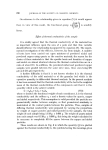
SAMPLING AND ASSESSMENT OF POWDER MIXTURES 261 random sampling offers the most useful approach. In the example quoted, if the million tablets are contained in a single large drum it would be necessary to select tablets as samples from random points in the drum. These points in the drum •vould previously be designated with numbers and the selection of sampling points achieved by consultation with tables of random numbers. Sampling may be most beneficially achieved by a common-sense approach and comparing the use of the powder mixture or its next stage in processing with the method of sampling. Thus in the production of tablets, sampling is best achieved by taking individual tablets as individual spot samples, since the tabletting may be regarded as a sampling operation. It may be argued that machine vibration, etc. will cause a sampling bias by influencing segregation to occur within the hopper. However, all sampling operations are liable to promote some segregation and it is far more expedient to examine the final product than to use other techniques in this case. For pigment powder mixtures intended for cosmetic use, samples may be taken and examined by reflectance techniques. Sampling here may be achieved with the use of the more conventional thief or the reflectance measured directly using a light-probe technique (1) to sample the pigment mixture in situ. Much has been written on the subject of the sample size or unit of scrutiny. Poole, Taylor and Wall (2) found a relation between the observed coefficient of variation between sample concentrations C, and the number of particles taken in each spot sample N. log C=m log N+constant where the value of m has the value of --0.5 for completely randomized mixtures and zero for completely unmixed systems. These limiting con- ditions had earlier been described by Lacey (3) for binary mixtures of uniform powders, thus the standard deviation of sample concentration for an unmixed system, %, is given by C•o,-(xy) t and that for a randomized mixture, (•R, by •R = (xy/N)'• where x and y are the proportions of the two ingredients in the mixture. Since a statistical measure of variation in sample concentration is dependent upon the number of particles and hence the size of the sample, the scale of scrutiny must be set at the unit of the mass that is to be used either by a consumer or at the next stage of processing. In the case of
Purchased for the exclusive use of nofirst nolast (unknown)
From: SCC Media Library & Resource Center (library.scconline.org)