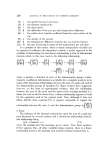
THERMAL CONDUCTIVITY EFFECTS IN THE DIFFERENTIAL THERMAL ETC. 227 and R is detined as R::2(d2--d l) (lII) d2+di •vhei'e d t and d2 are the apertures, in micrometres, of the smaller and larger sieves between which the sample had been sized. Upon fitting the experimental data by the appropriate statistical methods, rdationship of the form given in equation {I) was found such that A = 106 q- 1.6 X 10⁻⁴M--9R, where A is in mm2. (IV) It is clear from this equation that a change in the value of M from 20 to 2 000 gm introduces a change of about 3% in the area whilst a change in R from 0.2 to 2 introduces a change of about 16ø,/o . Hence, it is clear that whilst the influence of mean particle size upon the area of a peak is probably negligible, the range of particle size has a considerable effect. This conclusion suggests that great care must be taken when comparing the result of differential thermal analyses for a graded sample and, for example, a sample which has been ground in a mill so producing a con- siderable change in the spread of particle size. It should be noted, however, that corrections to data on the basis of the relationship given in equation {VI) must be applied with caution, since the actuM range of particle size of a powder will depend largely upon the sharpness of the grading technique involved. This dependence of the area of a peak upon the range of particle size but independence of mean particle size would, in fact, be expected. Thus, materials having the same spread but different mean particle sizes would be expected to have sensibly similar values of voidage. Since, how- ever, the space between larger particles can be filled with smaller particles, it would be reasonable to expect that higher densities of packing (lower voidages) of the powder would be obtained with powders which have a wide spread of particle size. These differences in density of packing of the sample would affect the thermal properties of the sample and so affect the area of the peak of a thermogram. 'I'HEORETICAL ANALYSIS OF THE PROBLEM A little thought will suggest that the area, A, of a peak of a thermo- gram depends upon the following variables: (1) O the mass of the sample (2) H the heat of reaction per unit mass (3) q the rate of heat liberation or absorption per unit mass

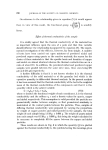
228 JOURNAL OF THE SOCIETY OF COSMETIC CHEMISTS (4) c (5) k (6) s (7) [• (s) e (9) p (lO) o the specific heat per unit mass the thermal conductivity the chart speed the deflection of the pen per unit temperature difference the surface heat transfer coefficient from the outer surface of the cup the density of the powder the temperature difference between the cup and the furnace R the rate of heating in terms of the temperature per unit time. In a problem of this nature, where so many independent variables can be expected to influence the dependent variable, a useful approach to the problem of determining the functional relationships is that of dimensional analysis which, in this case, leads to the following relationship: AR2• /QR2t where , denotes a function of each of the dimensionless groups. Unfor- tunately, insufficient information is available for a complete analysis to be •nade of the functional relationships between the area of a peak and each of the dimensionless groups of equation (V). Many workers have suggested, however, on the basis of experimental evidence, that the relationship between the area of the peak and the mass of the reacting material is a linear one and, as will be shown later, a linear relationship appears to hold for the apparatus used in the present work. Thus, although it does not follow directly from equation (V), it appears reasonable to suggest the relationship between the area A and the dimensionless group qOl• e02• is linear. The influence of the thermal conductivity upon the area of a peak has been discussed by several workers and a theoretical relationship derived, this relationship being Q/A--Constant X lc (VI) where the symbols have the meanings given earlier. Thus from equation (VI) it appears that, all other variables being constant, there is a linear relationship between the quantity Q/A and the thermal conductivity, k.
Purchased for the exclusive use of nofirst nolast (unknown)
From: SCC Media Library & Resource Center (library.scconline.org)