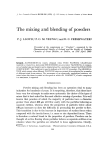
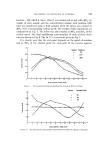
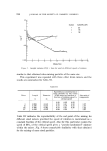
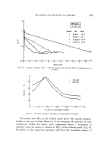
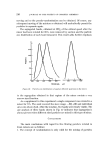
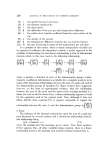
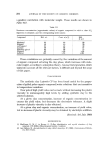
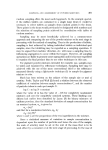
'DIE MIXING AND BLENDING OF POWDERS 207 o.ool- o '_••Ng•. Symbol Run Mixer [] - \'x.•52O/oCS.1•'"%,, ,• R-SV-I M-4 %•3• .......... • x R-SIll-2 M-2 - • • o R-ASI-I M-2 = I -] I I I I I I I 20 40 60 80 100 120 140 160 180 Mixing time Figure 1. Sa•nple variance S2(t) v. time for same sized particles. 3. All mixtures will tend to a recognisable end point characterised by the 2 fully randomised mixture and the between sample variance b where R 2 p(1--p) where n is the number o --= (n) tt n of particles per sample for the mixing of monosized particle differing only by colour, Lacey (2) and for particles of different size, Stange {3) 2 Pq R ' pV. (I+C•)+qVp (I+C•) where p and q are the weight fraction of the mixed components Vp and Vq are average particle weight of components p & q Cp and C a are the coefficient of variation of components p & q for particles of differing size. Lloyd and Yeung (4) have examined the basic tenets under which these conclusions might be based and by a stochastic analogy have derived a law similar to Fick's second law. However, two restricting assumptions have to be made before this law can be obtained.

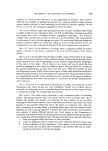
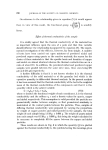
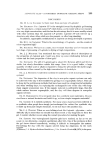
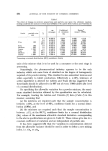
208 JOURNAL OF THE SOCIETY OF COSMETIC CHEMISTS (1) That the elemental volume within the mixture occupied by one species can only be occupied by one particle of the second species, {2) that the momentum transfer between colliding particles is independent of the mass of the particles. 2 LnSo I,n S • 2 I.n S R Mixing time Figure, '2, Sketch used to illustrate scale up procedure This means that the Fick's type of law can only be obtained when the particles of each species are of the same size and density. Furthermore, from the development of the theory it is seen that the diffusion coefficient, or as the authors prefer to call it the migration coefficient, will depend on both the material and the mixer. If these assumptions are not followed it can be shown that the mixing process is folloxved by the second Kolmol- gorov equation also developed by Rumpf and Mueller {5) • p •2p • p (•V) •?t = D •x2 1t dx Solutions of this equation do not lead to the final state of a fully randomised mixture but will lead to an end point in the mixing process where each component has a concentration-position profile and the mixing of the com- ponents can not be completed. EXPERIMENTAL INVESTIGATION The experimental programme was designed to try to separate the
Purchased for the exclusive use of nofirst nolast (unknown)
From: SCC Media Library & Resource Center (library.scconline.org)