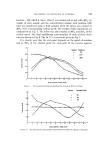
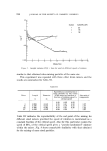
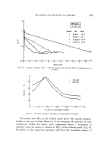
252 JOURNAL OF THE SOCIETY OF COSMETIC CHEMISTS The increase of yield value is caused by the presence of a greater con- centration of structure-forming elements. Since the plastic viscosity is measured under high shear, when the interparticle bonds are broken down, the Einstein equation may be applied to it as a first approximation, i.e. the plastic viscosity should increase linearly with the volume concentration of the disperse phase. The small change of clarity indicates that, although there is inter- particle bonding throughout the volume, flocculation, that is, the for- mation of small, densely packed groups of particles, does not occur. 2. When the concentration of the organic compound is increased, the yield value at first drops a little, then increases very rapidly, and finally decreases rapidly. At the same time, the clarity first improves, then remains nearly constant, until, at the peak yield value, flocculation starts. These effects, including the initial surprising changes, may be explained as follows:- It is well known that clay minerals of the smectite class absorb polar organic compounds on their silica surfaces. MacEwan (1) has reported that the organic liquids arrange themselves in up to three molecular layers between oriented clay lamellae. The low yield value of Laponite CP dis- persions in distilled water suggests that the particles are almost completely dispersed. The adsorption of small amounts of polar organic compound causes some oriented aggregation of the lamellae, and thus an effective reduction of the number of particles available for structure formation. The yield value, therefore, drops. Since only a limited amount of polar organic compound can be accommodated, (the maximum is approximately equal to the weight of the clay), at higher concentrations there is always a surplus in the medium. The effect of polar organic compounds on clay dispersions has been well described by van Olphen (2), whose arguments are used below. The thickness of the electrical double layer decreases when the dielectric constant of the medium is reduced, and such a reduction may be achieved by the presence of water-miscible solvents, such as alcohols or acetone. Consequently, the range of particle repulsion is reduced, allowing stronger interparticle bonding, that is, an increase of the yield value. At high con- centrations, the repulsive forces have a very short range and gross floccu- lation by Van der Waals forces can occur the yield value, therefore, goes through a peak, and the optical density suddenly increases. The changes of plastic viscosity are largely caused by the variations of the viscosity of the medium. The contribution from the clay is not con- stant, but increases. This still agrees with the Einstein equation if we

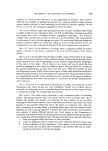
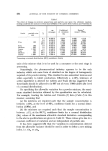
LAPONITE CLAY--A SYNTHETIC INORGANIC GELLING AGENT 253 assume that the total volume of the disperse phase increases by the ad- sorption of the organic compound with increasing concentration {Table VI for glycerol and ethanol examples). Table VI The contribution of the clay phase to the plastic viscosity (cP) of dispersions at 25øC (a) Glycerol Concentration of without glycerol % clay 20 1.6 40 3.2 50 5.1 60 9.0 with 2 •o Laponite C P 4.1 7.3 10.8 15.1 contribution of clay 2.5 4.1 5.7 6.1 (b} Ethanol Concentration of without with 2 •o contribution ethanol •o clay Laponite CP of clay 10 1.3 2O 1.8 30 2.2 40 I 2.4 50 2.4 2.4 3.4 5.0 5.1 5.5 1.1 1.6 2.8 2.7 3.1 3. The effect of adding varying amounts of electrolyte are somewhat similar to the above. The yield value increases, and goes through a peak, because the electrolyte causes a reduction of the thickness of the double layerl •: just'as in' the presence of pola•r organic •olvents. The p•ak is, in fact, not always observed in the measured values of ESS, because the flocs are of such a size as to be able to bridge the gap between cone and plate on the viscometer, as has been mentioned before. The optical density also changes suddenly when flocculation occurs, as in the case of organic addition. The plastic viscosity of the systems changes very little with electrolyte addition, as there is no change in the viscosity of the medium, nor in the total volume of the disperse phase. Comparison of the different organic compounds also yields some inter- esting correlations. Although the maximum concentration of organic compound in which a clear 2% dispersion of laponite can be obtained, has not been accurately determined, the approximate values available show a fairly good positive correlation with molecular weight. The yield values corresponding to these concentrations can also be estimated by interpolation, and they also show
Purchased for the exclusive use of nofirst nolast (unknown)
From: SCC Media Library & Resource Center (library.scconline.org)