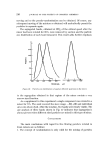
THERMAL CONDUCTIVITY EFFECTS IN THE DIFFERENTIAL THERMAL ETC. 235 a transition or reaction occurs then the change in temperature of the sample relative to some inert reference material being heated at the same rate might well be used to control the process. I can not think of many instances, in practice, where this would be applicable. Where a simple comparative measure is required, provided the apparatus is care- fully calibrated and the material exhibits a suitable reaction, the technique of differ- ential thermal analysis is a useful and reliable method of determining small quantities of a component. The method, however, is static in the sense that a sample must be taken from the bulk material and, of course, the question also arises of how representative a sample of a few milligrams is compared with what might be tons of the material in bulk. Ds. R. Pu6H: In page 227 you made the comment that the area of a peak is dependent upon the range of particle size but independent of the mean particle size, which xvould be expected. Would you care to elaborate? THE LECTURER: For a given mean particle size of a powdered sample the material might consist of a series of ranges of particle size from the smallest to the largest particle. For different ranges of particle size, however, there will be different patterns of packing. For example, in a cubical array with the smaller particles just fitting in the spaces between the larger particles the ratio of the diameters of the smaller particles to the larger particles will be 0.7. This arrangement will produce a higher density of packing than is the case where the smaller particles are larger than 0.7 of the diameter of the largest particles. Thus the bulk density is dependent upon the range of sizes of particles in the sample, and changes in bulk density could reasonably be expected to affect the thermal properies of the sample which in turn will affect the relationship between the area of a peak and the mass of reactant. It is also worth emphasizing that, as is stated in the paper, equation IV cannot be applied precisely because the particle size range will depend upon the method by which the sample is cut. In this case the samples •vere sized by sieving, and some error can be expected at either end of the particle size range.

J. Soc. Cosmetic Chemists 21 237-258 (1970} ¸ 197o Society oj Cosmetic Chemists of Great Britain Laponite claya synthetic inorganic gelling agent for aqueous solutions of polar organic compounds BARBARA S. NEUMANN and K. G. SANSOM* Presented at the Symposium on "Guins and Thickeners", organised by the Society of Cosmetic Chemists of Great Britain, at Oxford, on 14th October 1969. Synopsis---The formation of GELS in AQUEOUS SOLUTIONS of POLAR ORGANIC COMPOUNDS by the use of a SYNTHETIC SWELLING CLAY (LA PONITE ½P) has been studied. There is a maximum CONCENTRATION for each compound in which clear dis- persions can be made, and this increases with the MOLECULAR WEIGHT of the organic compound. The DISPERSIONS are between pseudo-plastic and Bingham fluids. The yield value increases with clay concentration without loss of clarity. Addition of ELECTROLYTE or further amounts of organic compound cause an increase in the yield value, but flocculation occurs at high levels. Tentative explanations are offered for the phenomena observed. INTRODUCTION The rheological properties of disperse systems show great variations of viscosity and yield value. These are caused by differences in the inherent properties of the particles of the disperse phase and the presence or absence of interparticle structure formed. It is well known, for example, that systems of high viscosity can be obtained from certain long-chain polymeric compounds and, if there is little interparticle bonding, the dispersions have low yield value. Similarly, it is well known that systems of low viscosity and high yield value are readily formed from certain materials composed of lameIlar or acicular particles which can build up structures based on interparticle association. Typical examples of the first type of material are most of the cellulose *Laporte Industries Ltd., Redhill, Surrey. 237
Purchased for the exclusive use of nofirst nolast (unknown)
From: SCC Media Library & Resource Center (library.scconline.org)