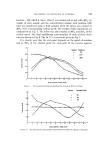
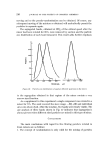
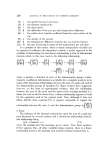
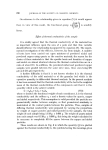
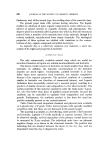
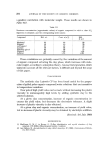
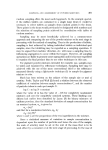
TIlE MIXING AND BLENDING OF POWDERS 213 fraction --52/+60 B.S. Sieve. Mixer I was loaded end to end with 50% by weight of each sample and the concentration change with position with time was monitored using a thief sampler when the mixer was rotated at 20% of the corresponding critical speed. The results of this experiment are summarised in Fig. 5. The mixer was also rotated at 35% and 52ø/0 of the critical speed. The final equilibrium concentration of each of these three runs are shown in Fig. 6. The 1 n. S 2 v t curves are given in Fig. 7. It is clearly seen that the end point depends on the speed of rotation and at 35% of the critical speed the end point of the process appears ].0-- 0.8 l 0.6-- 0.4-- 0.2-- Figure ,5. Symbol Time(rain) ,• 30 x/• x 270 o 580 I I I I I I I I 5 6 7 8 9 I0 II 12 Axial position along mixer The axial concentration distribution of sand at 20 • of critical. 0• '• õ o,• O2 Figure Symbol Speed(%C.S.R.) I 2 3 4 5 6 7 8 9 I0 II 12 Axial position along mixer The final axial concentration distribution at different speeds of rotation.

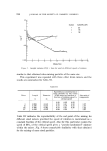
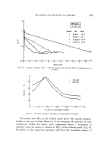
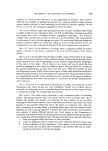
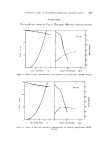
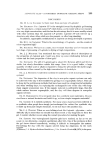
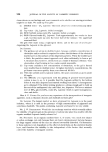
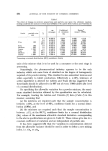
214 JOURNAL OF THE SOCIETY OF COSMETIC CHEMISTS OOl Symbol Speed (% CS.R.) x 20 • 35 o 52 0 0010 2 4 6 8 I0 12 14 16 18 20 Mixincj time Figure 7. Sample variance S2(t) v. time for sand at different speeds of rotation. similar to that obtained when mixing particles of the same size. This experiment was repeated with three other drum mixers and the results are summarised in Table III. Table IIl I Equilibrium concentration of large particles at the centre Mixer Length Diameter of the mixer as function of Size ratio of fraction of rotation speed to components m m critical speed 0.20 0.35 0.52 I 0.295 0.145 0.70 0.51 0.32 1.27 1I 0.150 0.145 0.72 0.49 0.32 1.27 lII 0.180 0.182 0.73 0.51 0.36 1.27 IV 0.445 0.145 0.68 0.50 -- 1.27 Table III indicates the reproducibility of the end point of the mixing for different sized mixers provided the speed of rotation is maintained as a constant fraction of the critical speed. Also for this particular system the speed of 35% of the critical speed gives a "pseudo-randomised" mixture within the mixer. Fig. 8 shows remarkable similarity with that obtained for the mixing of same sized particles.
Purchased for the exclusive use of nofirst nolast (unknown)
From: SCC Media Library & Resource Center (library.scconline.org)