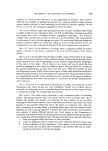
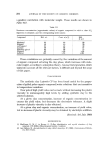
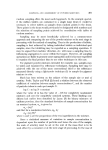
264 JOURNAL OF THE SOCIETY OF COSMETIC CHEMISTS Table I The effect of change in mixture proportions and particle size upon the ultimate random- mixing condition for mixtures of fine sand (160gin) with calcite from Ashton and Valentin (7) Calcite ..... (• Coefficient Range* (Stange) of variation mean + 1.96(•R Grade particle size •o (%) 0.1 0.005 2 5.200 0.090 0.110 1.0 0.016 4 1.640 0.968 1.032 Fine 155 10.0 0.049 6 0.496 9.903 10.097 50.0 0.084 0 0.168 49.830 50.160 Fine 155 1.0 0.016 4 1.640 0.968 1.032 Medium 335 1.0 0.050 3 5.030 0.901 1.099 Coarse 1 200 1.0 0.342 0 34.200 0.330 1.670 Fine 155 50.0 0.084 0 0.168 49.830 50.160 Medium 335 50.0 0.190 0 0.380 49.630 50.370 Coarse 1 200 50.0 1.222 0 2.440 47.600 52.400 *assuming a normal distribution (95 •o confidence limits) unit of the mixture that is to be used by a consumer or the next stage in processing. Surprisingly, the pharmaceutical industry appears to be the only industry which sets some form of standard on the degree of homogeneity required of its powder mixing. This standard is also somewhat tenuous and refers especially to tablet production. Effectively a + 10% tolerance of active ingredient is allowed for tablets and Train (4) has suggested that these limits should be adhered to in 997 out of every 1 000 tablets (3• level of a normal distribution). By specifying the allowable variation for a powder mixture, the maxi- mum standard deviation allowed by the specification can be calculated. For example, treating the Ashton and Valentin (7) data (Table I) in this manner, assuming that {a) the mixtures are required such that the sample concentration is between + 10% at the level of 95% confidence limits for a normal distri- bution (1.96•), and {b) the mixtures are required such that the sample concentration is between + 1% at the 99.7% confidence limits for a normal distribution (3•), values of the maximum allowable standard deviation corresponding to the above specifications are given in Table II. These values give rise to a constant coefficient of variation and are independent of particle size. It has been suggested (8) that the variation in concentration derived from the allowable variance should be used in order to define a new mixing index, i.e. s/• A or s/%

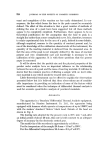
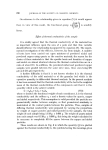
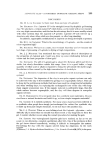
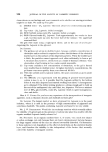
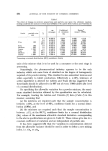
SAMPLING AND ASSESSMENT OF POWDER MIXTURES 265 Such an index depends on the specification adopted and must be clearly defined together with the specification, e.g. 10/• 5 __ S/C•^ Bi G v __ where B is the mixing index, the superscript 10/95 indicating the allowable variation (+ 10%) and confidence limits (95%) assuming a normal distri- bution. The subscript indicating the unit of scrutiny (1G). Table II Calculation of maximum allowable standard deviation front Ashton and Valentin's data (specifications of _+ 10•o at 05•o confidence lintits and ñ 1 •o at 99.7•o confidence limits} Calcite Grade Fine Fine Medium Coarse Fine Medium Coarse Particle size 155 155 335 1 200 155 335 1 2OO (Stange) 0.1 1.0 10.0 50.0 1.0 1.0 1.0 50.0 50.0 50.0 0.005 2 0.016 4 0.049 6 0.084 0 0.016 4 0.050 3 0.342 0 0.084 0 O. 190 0 1.222 0 Allowable variance +10% at 95 •o Confidence lintits Range _0.01 4-0.10 4- 1.00 +5.00 _0.10 +0.10 +0.10 +5.00 +5.00 ñ 5.00 0.005 -0 •- 0.052 0.520 • 2.550 , 0.052 0 [ 0.052 0.052 g 2.550 00 2.550 2.550 0 Allowable variance at 99.7 •o Confidence limits Range (•s q- 0.001 0.000 3 + 0.010 0.033 0 q- O. 100 0.003 3 ñ 0.500 0.167 0 _ 0.010 0.003 3 q- 0.010 0.003 3 ñ O.OLO 0.003 3 ñ0.500 0.167 0 ñ0.500 0.167 0 q- 0.500 0.167 0 The use of a varying specification for the homogeneity required of the powder mixture does not enable the index to be used for the comparison of powder mixtures by different workers. It is therefore suggested that some specification is adopted for such comparison, say B 1/95 i.e. a variation 1G' of sample concentration of +1% at 95% confidence limits assuming a normal distribution and using 1G samples as the unit of scrutiny. In order to convert this index to a specification required in practice i.e. B 1/95 to B M/n 1G g 1/95 S1G where B -- 1G 61/95 and BP/n_ Sg O'p/n
Purchased for the exclusive use of nofirst nolast (unknown)
From: SCC Media Library & Resource Center (library.scconline.org)