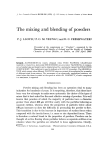
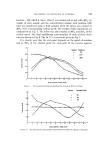
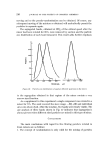
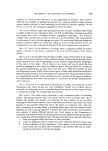
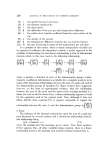
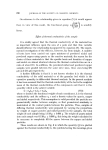
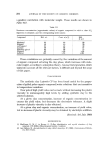
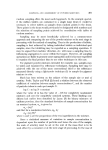
THERMAL CONDUCTIVITY EFFECTS IN THE DIFFERENTIAL THERMAL ETC. 225 BLOCK PLATINUM CRUCIBLE MOCOU PL E •/•/I R E 5. BASEPLATE. SCALE - FULL S•ZE. Figure 3 Thermocouple head with 5'intox block It should be noted that the above figures are approximate since the sensitivity of the thermocouples varies •vith temperature. It must also be pointed out that the results are very dependent upon the characteristics of the apparatus used and the results presented are, strictly, applicable only to the apparatus used for this work. DEFINITION OF THE AREA oe)F A PEAK As stated earlier, with the present state of knowledge all methods of defining the area of a peak are empirical. With the apparatus used in the present work it has been found that the portion of the differential tempera- ture curve before the onset of a peak is, sensibly, a straight line and so the method of defining the area of a peak adopted in the present analysis is as

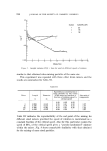
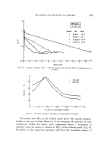
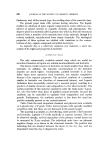
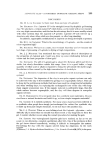
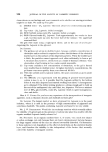
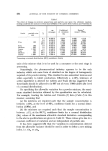
22(3 JOURNAL OF THE SOCIETY OF COSMETIC CHEMISTS c Figure 4 shown in Fig. 4. It can be seen from Fig. 4 that the base to a peak is simply constructed by producing the straight portion CD of the differential temper- ature curve to F and the area of the peak is taken as the shaded area DEF. EFFECT OF PARTICLE SIZE AND PARTICLE SIZE RANGE UPON PEAK AREA A study of the literature shows that there is considerable doubt as to xvhether the area of the peak is influenced by the particle size characteristics of the powder. In view of the importance of this question I have made a study of the effects of both the mean particle size and the particle size range, this work being published in an earlier paper (1). In this earlier work, 47 differential thermal analyses were made upon an equal number of samples taken from 13 batches of natural quartz, the batches having been graded between various sieves to give various values of mean particle size and of the 'spread' of particle size. On the basis of the assumption that the re- lationship between the area of the peak and the two independent variables, mean particle size, and the range of particle size is linear, the statistical technique of multiple linear regression was used to obtain an equation of the form A-•K+¾M+aR (l) where A is the area of the peak, K, ¾ and b are constants, M is the mean particle size and R is the range of particle size. For the purposes of the analysis M is defined as dlq-d 2
Purchased for the exclusive use of nofirst nolast (unknown)
From: SCC Media Library & Resource Center (library.scconline.org)