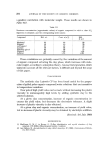
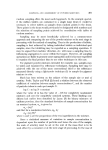
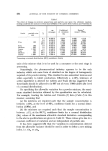
LAPONITE CLAY--A SYNTHETIC INORGANIC GELLING AGENT 253 assume that the total volume of the disperse phase increases by the ad- sorption of the organic compound with increasing concentration {Table VI for glycerol and ethanol examples). Table VI The contribution of the clay phase to the plastic viscosity (cP) of dispersions at 25øC (a) Glycerol Concentration of without glycerol % clay 20 1.6 40 3.2 50 5.1 60 9.0 with 2 •o Laponite C P 4.1 7.3 10.8 15.1 contribution of clay 2.5 4.1 5.7 6.1 (b} Ethanol Concentration of without with 2 •o contribution ethanol •o clay Laponite CP of clay 10 1.3 2O 1.8 30 2.2 40 I 2.4 50 2.4 2.4 3.4 5.0 5.1 5.5 1.1 1.6 2.8 2.7 3.1 3. The effect of adding varying amounts of electrolyte are somewhat similar to the above. The yield value increases, and goes through a peak, because the electrolyte causes a reduction of the thickness of the double layerl •: just'as in' the presence of pola•r organic •olvents. The p•ak is, in fact, not always observed in the measured values of ESS, because the flocs are of such a size as to be able to bridge the gap between cone and plate on the viscometer, as has been mentioned before. The optical density also changes suddenly when flocculation occurs, as in the case of organic addition. The plastic viscosity of the systems changes very little with electrolyte addition, as there is no change in the viscosity of the medium, nor in the total volume of the disperse phase. Comparison of the different organic compounds also yields some inter- esting correlations. Although the maximum concentration of organic compound in which a clear 2% dispersion of laponite can be obtained, has not been accurately determined, the approximate values available show a fairly good positive correlation with molecular weight. The yield values corresponding to these concentrations can also be estimated by interpolation, and they also show

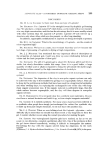
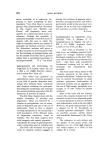
254 JOURNAL OF THE SOCIETY OF COSMETIC CHEMISTS a positive correlation with molecular weight. These results are shown in Table VII. Table VII Maximum concentration (approximate values) of organic compound in which a clear dispersion is obtained, and the corresponding yield values:- Compound Mol. wt. Conc. w/W•o ESS Nm-2 Methanol Ethanol isoPropanol Acetone Ethylene glycol Glycerol Sorbitol 32 46 60 58 62 92 182 4O 4O 45 55 55 60 70 23 30 32 47 17 55 231 These correlations are probably caused by the variations of the amount of organic compound solvating the clay phase, which increases with mole- cular weight, according to adsorption theory. An exact interpretation, which takes into account all the relevant factors, is difficult and beyond the scope of this paper. I•ONCLUSIONS The synthetic clay Laponite CP has been found useful for the prepar- ation of gelled polar organic compound/water solutions that are insensitive to temperature variations. Clear gels of high yield value can be made without increasing the plastic viscosity to unmanageably high levels by adding synthetic clay to the selected solution. At a given clay concentration, increase of organic concentration in- creases the yield value, but decreases the electrolyte tolerance. A slight increase of plastic viscosity is also obtained. At a given clay and organic concentration, an increase of yield value, but no increase of plastic viscosity may be obtained by electrolyte addition. (Received: 3rd July 1969) REFERENCES (1) MacEwan, D. M. C. in Brown, G. X-Ray identification and crystal structures of clay minerals. 176 (1961) (Mineralogical Society, London). (2) van Olphen, H. An introduction to clay colloid chemistry, 47 (1963). (Interscience Publish- ers, Nexv York).
Purchased for the exclusive use of nofirst nolast (unknown)
From: SCC Media Library & Resource Center (library.scconline.org)