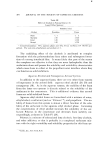
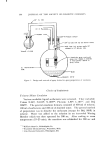
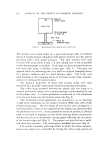
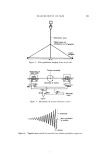
400 JOURNAL OF THE SOCIETY OF COSMETIC CHEMISTS Determination of Surj•actant G-2151 in Toluene-G-2151-Water Emulsions G-2151 in Water Phase--Replicate samples of the emulsion were placed in two 30-ram, 4 ø sector cells and centrifuged at 1,967 rpm in the Beckman Model E Analytical Ultracentrifuge for the minimum time sufficient to allow complete clearing of the dispersed phase (ca. 500 sec for an emulsion with 1% G-2151 and 50% toluene). The cells were placed backwards in the rotor so that the water phase sediments towards the filling plug. After centrifugation, the water phase was carehfily removed with a syringe equipped with a short needle (so that cream can- not be penetrated) and 0.1 cc of water phase from each cell was placed in a 5-ml volumetric flask. Sufficient I?KI stock solution was added so that the concentration of I,and KI in the final solution was 1 x 10⁻⁴M in each and the flask was brought to volume with water. Within 5 rain the ab- sorbance of the solution as a function of Zm• was determined in the Cary Model 15 Spectrophotometer. The concentration, C, of (¾2151 was de- termined from A•.• -- Ag40 = (2.57 x 10 -g) C or from Aa00 -- A,a ---- (4.75 x 10 -4) C, where the wavelengths were chosen such that the ab- sorbances of I,-- I- in the absence of suffactant were equal for a given pair i.e., 303 = '•340 A300 = A275 and where C is in rag/100 mi. The details of this sensitive assay will be published elsewhere. G-2151 in Total Emulsion--The theoretical maximum surfactant concentration possible in the total emulsion is the concentration of G-2151 in toluene surfactant solution multiplied by the amount (ff tolu- ene available for spraying on to the water phase divided by the volume of emulsion. In the preparative procedure utilized, all the ( -2151 was added in the toluene. The theoretical minimum is the concentration of G-2151 in the toluene surfactant solution multiplied by the amount of toluene found by assay in emulsion divided by the volume of emulsion. In the preparative procedure utilized, some of the toluene sprayed on the water was lost due to vaporization and in the apparatus. Thus, the amount found in the emulsion was not the same as the amount added. Approximately 5 g of emulsion was weighed into a 50-ml flask and about 40 cc of water was added. The mixture was shaken to extract surfactant into the water phase and then allowed to stand at either atmospheric pressure or under vacuum until no perceptible trace of

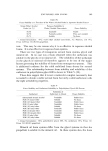
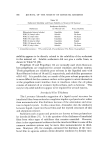
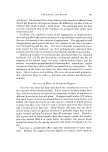
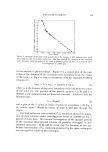
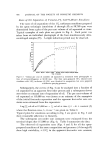
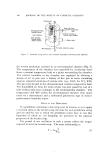
EMULSION STABILITY 401 toluene remained. The flask was brought to volume and 2 ml of the solution was placed in a 10-ml volumetric flask. Five ml of 2 x 10⁻⁴M I2 and KI was added, the solution was brought to volume, and the absorbaucc was determined within 5 min of the I2-KI addition. The concentration ot: the G-2151 was determined from this absorbance as previously described for G-2151 in the water phase. At least partial vaporizatiou of the toluene was necessary to avoid obscuring the I,,-I-- (G-2151) absorption spectra below 290 m/•. Assay of Tetradecane in Tetradecane-Water-Igepal Co-610 Emulsions Ten ml of the emulsion was placed in a vial and 10 ml of 10% aqueous Na.,..q()4 solution was added. The vials were capped, shaken, and maintained in an oven at 80øC. The emulsion was completely broken withiu 7 hours. Ten ml of ether was added to the cooled emul- sion and the mixture was shaken. A ml of the ethereal layer was added to 0.10 ml of the dodecane to be used as an internal standard in a 50-ml voltanettie flask. The flask was filled to volume and 0.005 ml was in- jeered in an F and M Gas Chromatograph equipped with a flame ioniza- tion detector. The settings were: injection port temperature, 160øC detector temperature, 250øC and column oven temperature, 90øC. The range setting was 102 and the attenuation at 2. The column was an 8-ft circular column containing 20% Carbowax 20 M on 60 to 80 mesh Chromosorb W. The gas chromatogram consisted of three peaks: the first due to ether, the second due to dodecane, and the last due to tetra- decane. The gas chromatogxams were evaluated by obtaining the ratio of tetradecane peak height, ht, to that of dodecane, ha. The plot ot5 this ratio against tetradecane concentration was linear so that ht/ha -- 0.0269 Con q- 0.109 when Con is in grams of oil/100 ml of emulsion. The stan- dard deviation about regression was 8.1 x l0 -a and the standard deviation ot5 the slope was 3.43 x 10 -4. Determi•t. ation of S•tr[actant Igepal Co-610 in Tetradecane-Water- Igepal Co-610 Emulsions This surfactant had ultraviolet absorption maxima at 270 mv and 220 rev. The absorbance ot5 aqueous solutions obeyed Beer's law at the latter wavelength. For a concentration ot5 0.018 g/1., the 95% confidence limits by spectral assay at 220 mv were less than 5%. The equilibrium concentration of suffactant in the aqueous phase of the emulsion was determined by assaying the aqueous phase after creaming by centrifuga- tion at 3,000 rpm.
Purchased for the exclusive use of nofirst nolast (unknown)
From: SCC Media Library & Resource Center (library.scconline.org)