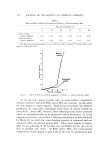
398 JOURNAL OF THE SOCIETY OF COSMETIC CHEMISTS Igepal Co.©* Surfactants--These were of the general chemical struc- ture, CoH•9---•O(CH2CH20)n-• CHzCHzOH, where n is the number o[ total ethylene oxide units. The cmc of these surfactants is about 0.01% w/v. Triton Sur[acta•ts--Those of chemical structure CsHi7---•(0CH2CH2)x0H (Triton X) and CgH1o••(0CH2CH2)x (Triton N) were used, where x is the number of total ethylene oxide units. The cmc of these surfactants is about 0.01% w/v. PIuronic Surlactants--The chemical structure was HO(CH2H20),z- (CH-CH2o(CHeCHeO)cOH, where a and c are the numbers of ethylene I CHa oxide units and b is the number of propylene oxide units. The cmc is ca. 2.0% w/v (23). Atlas SurJ:actants-The surfactants used fall in one of the following three classes: (a) Tweens, sorbitan fatty acid esters (b) Myrj, poly- oxyalkylene fatty acid esters and (c) Brij, polyoxyalkylene fatty ethers. The cmc of these surfactants is about 0.01 to 0.1% w/v (24). Aqueous solutions were made with each of the surfactants at 4, 2, 1, and 0.5% w/v. Tetradecane in water (25% v/v) emulsions were prepared by shaking the oil surfactant solution mixture on a Vortex Jr. Mixer* for one minute. All the emulsions creamed quickly. Therefore, creaming could not be used as a criterion for screening purposes. All emulsions that showed oil separation within the first day after preparation were discarded. The rest were spun, after standing five days, in an International Centrifuge Model SBr* at 3,000 rpm for 0.5 hour. After centrifugation, the amount of oil separated was measured visually. In each set, the best emulsion was considered to be the one where the surfactant was soluble in water but insoluble in the oil where the emulsion did not separate oil standing at room temperature and where the emulsion did not separate an excessive amount of oil under centrifugation at 3,000 rpm. The best emulsions in the Igepal series were made with IG-CO-610 and IG-CO-630. TR-X-100 was the * General Aniline and Film Corp., New York, N.Y. * Scientific Industries, Inc., Queens Village, N. Y. • International Equipment Co., Boston, Mass.

EMULSION STABILITY 399 best in the Triton series, whereas P04 and P•0• were the best in the Pluronic series. The Atlas surfactants were limited to M20, i.e., G-2079. A series of tetradecane-water emulsions was prepared with these surfactants by the spraying method previously detailed using 2 cm of Hg pressure with nitrogen. Atlas G-2079 could not be used in the prepara- tive method. Igepal CO-610 and Pluronic P-94 were the best choices. They (10, 15, and 20% O/W, v/v, lr•o surfactant) passed through an 0.8-v filter pore size and 3-v filter pore size, respectively, and had a total creaming time of 8-12 hours. The emulsions prepared with the discarded surfactants creamed in less than an hour and the minimum filter pore sizes were larger. The emulsions with these chosen surfactants were centrifuged in the Beckman Model E Ultracentrifuge* at 2809, 5227, 9945, 29,500, and 50,740 rpm at 20øC. Creaming studies were possible with both sur- factants at low rates of speed. Free oil was not observed for 5,000 sec at 29,500 rpm but started at 2,500 sec at 40,740 rpm. Ultracentrifugal studies of the rates of free oil formation at 40,740 rpm were then con- ducted for 10, 15, and 20•o emulsions for both surfactants as functions of time. The initial rates of oil separation were 2 x 10-a% oil sep- arated per unit time for all emulsions. Since Igepal CO-610 is a liquid and produced a finer emulsion with tetradecane then the paste Pluronic P:}4, it was considered to be the surfactant of choice in the tetradecane- water system. The cmc value for Igepal-GO-610 is 17 x 10 -4 g/100 ml from surface tension measurements on the Du Nouy Tensiometer.* Analytical Methods Assay of Toluene in Toluene-G-2151-Water Emulsions Approximately 40-50 mg of a 40-50•o emulsion was accurately weighed into a tared 100-ml flask containing approximately 10-20 ml of 95% ethanol. The flask was brought to volrune with 95% ethanol and the solution absorbance was determined against an ethanol blank in the Cary Model 15 Spectrophotometer. The peak absorbances at 268 and 262 mt• were used to determine the concentration, C, from A2•s: (2.619 1./g)C and A•: (2.907 1./g)C. Beer's law holds in the presence and absence of G-2151 surfactant. Beckman Instruments Inc., Spinco Division, Palo Alto, Calif. E. H. Sargent and Co., Kensington, Md.
Purchased for the exclusive use of nofirst nolast (unknown)
From: SCC Media Library & Resource Center (library.scconline.org)