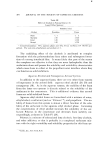
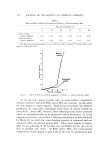
SURFACTANT LOCATION $67 and c()workers (16) conducted an investigation on a series of natural and symhetic oils but no direct correlation was found between the required HI,B values of the oils and the physical properties of the oils. It is generally known that the required HLB of an oil is dependent not only on the oil itself but also on the method by which the emulsion is prepared. This is a serious disadvantage in using the HLB system since, for a given value of required HLB, the exact method of emulsifica- tion must be specified. And, in using this value, the specified prepara- tire technique must be followed exactly to insure the desired results. Unless the extent of variations in required HLB caused by preparative variables is very small, such variations can, conceivably, cause serious manufacturing problems. In making emulsions, it is often difficult or impossible to keep the manufacturing conditions identical to the laboratory conditions used in developing the formulation. By necessity, or practicality, the mixing condition, cooling rate, the rate of phase combination, etc., in a full scale manufacturing operation are usually quite different from the laboratory scale operations. If, for example, a newly developed emulsion is stable only within a narrow range of HLB values, the variations introduced dur- ing the marefracturing operations can cause a shifting of the required HI,B and hence produce a mismatching of the HLB of the surfactant sys- tem and the required HLB of the oil system. This may lead to a produc- tion of emulsion with undesirable characteristics or poor stability. In spite of the apparent importance, very little is known about the extent effects of preparative variables on the required HLB of oils. In preparing emulsions, a combination rather than a single surfac- rant is generally used. The surfactant system may be initially placed in the oil phase, in the aqueous phase, or divided into both phases prior to emulsification. In earlier investigations, it was established that the initial location of the surfactants plays a significant role in determining the viscosity and particle size distribution, as well as the type of emulsion formed (17, 18). Since surfactants are generally somewhat soluble in both oil and water, a part of the surfactant placed initially in one of the phases will eventually migrate to the interface and the other phase to establish an equilibrium. However, the rate of such migration might be quite slow in some systems (19). The purpose ot• this study was to in- vestigate, specifically, if the initial surfactant location prior to emulsifi- cation had measurable effects on the required HLB of oils determined by emulsification. It was hoped that such information would be useful in

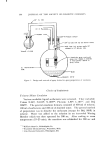
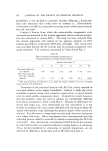
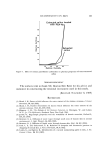
368 JOURNAL OF THE SOC1ETY OF COSMETIC CHEMISTS understanding the apparently complex effects ot• preparative variables on emulsions. EXPERIMENTAL All emulsification experiments were carried out in identical 600-ml Pyrex beakers using Lightnin mixers fitted with 2-in. stainless steel pro- pellers. The measured amount of water was first placed in a beaker and the required amount of the surfactant blend, having the desired HLB value, was then dispersed in the water with the propeller mixer. The oil phase was similarly prepared in a separate beaker. The amount ot• oil used was equivalent to 20% of the emulsion and the size of the batch was 400 g in all cases. Bet•ore emulsification, the propeller mixer was placed in the center ot• the beaker containing the aqueous phase. The clearance between the bottom ot• the beaker and the mixer tip was set at exactly 1/i in. The oil phase then caret•ully poured into the water phase. This opera- tion was done slowly to avoid emulsification prior to turning on the mixer. As soon as the oil phase was added, the mixer, set at 5(54 --4-_ 2 rpm, was turned on to start emulsification. The emulsion was mixed t•or exactly 3 minutes. In most cases, six batches with different HI J3 values were made simultaneously using six identical beakers and mixers. The experiments were carried out at 24øC. After preparation, the emulsions were poured into graduated cylin- ders and were observed for any sign of phase separation. The kill3 value of the surfactant blend yielding the most stable O/W e•nulsion was judged to be the required HLB of that system. At first, the emulsions were prepared with one HLB unit apart. After an approximate value of the required HLB was established, the experiment was repeated by making emulsions having 0.5 HLB unit apart until the required HLB value was established. The required HLB to form W/O emulsions was not studied in this investigation. All emulsions prepared had the following composition: Deionized water 77% Oil 20 Surt•actant mixture 3 The surt•actants used were Arlacel 80©* (HLB = 4.3) and Tween 80©* (HLB-- 15). * Arlacel 80 (sorbitan monooleate) and Tween 80 (polyoxyethylene sorbitan monoolcatc), Atlas Chemical Industries, Wilmington, Del.
Purchased for the exclusive use of nofirst nolast (unknown)
From: SCC Media Library & Resource Center (library.scconline.org)