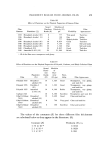
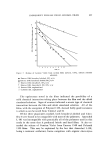
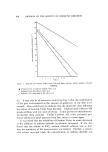
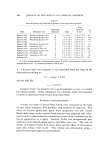
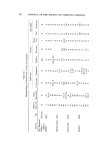
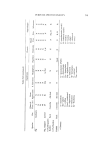
J. Soc. Cosmet. Chem., 21, 645-660 (Sept. 17, 1970) The Rheological Evaluation of Semisolids LAWRENCE H. BLOCK, Ph.D., *• and PETER P. LAMY, Ph.D. '- Presented September 9, 1969, Seminar, St. Lo•tis, Mo. Synopsis--Absolute RHEOLOGICAL measurements of SEMISOLIDS including: (1) evalua- tion of the interrelationship between the SHEAR stress and the shear rate (2) determination of product behavior during continuous shear and (3) characterization of the static structure of the product are described. Some of the problems encountered are discussed with special reference to time-dependent materials. RHEOMETERS which can be employed for theological evaluation of semisolids are discussed in terms of the design factors that should be incorporated. A device used in the food industry (the KRAMER SHEAR-PRESS) is con- sidered in some detail as it permits the continuous monitoring of sample behavior during shear and can simulate processing and usage conditions due to the availability of a variety of test cells and pistons. Some other theological criteria--tensile strength and shear strength (yield value)--are also described along with the use of the ROTOVISCO rheometer in meas- uring yield stress and equilibrium stress values of semisolids. INTRODUCTION Empirical methods have often been employed to evaluate certain facets of cosmetic product behavior which are related to the rheological properties of the system. Empirical methods often yield results which are difficult, if not impossible, to replicate (1). Empirical methods suffer by comparison with absolute methods since the former do not lend them- selves to mathematical characterization nor do they often permit a study of product behavior under a variety of conditions (1, 2). Thus, absolute rheological measurements are generally preferred by the serious cosmetic rheologist. * School of Pharmacy, Duquesne University, Pittsburgh, Pa. 15219. ? School of Pharmacy, University of Maryland, Baltimore, Md. 21201. 645

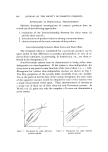
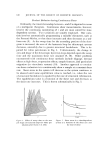
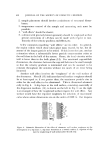
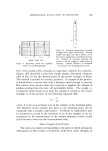
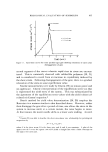
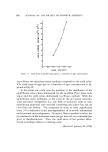
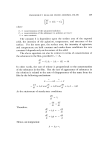
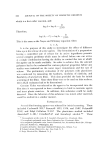
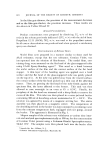
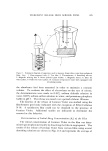
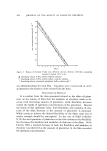
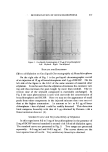
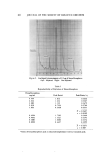
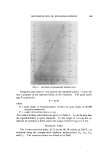
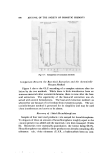
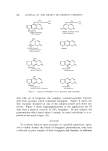
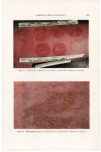
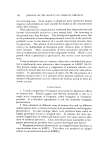
646 JOURNAL OF THE SOCIETY OF COSMETIC CHEMISTS APPROACHES TO RHEOLOGICAL MEASUREMENTS Absolute rheological investigations of cosmetic products have in- volved one of the following approaches: 1. evaluation of the interrelationship between the shear stress (r) and the shear rate (D) 2. determination of product behavior during continuous shear 3. characterization of the static structure of the product. Interrelationship between Shear Stress and Shear Rate The rheogram which is established for a particular product can be quite useful in that differences in product spreadability, in ease of re- moval from containers, in processing, in formulation, etc., are often re- flected in the rheograms (3, 4). Non-Newtonian systems may be characterized as being either time- independent or time-dependent. If the system is time-independent, the shear stress at any point is some function of the rate of shear, i.e., •- ---- f(D). Rheograms for various time-independent systems are shown in Fig. 1. The flow properties of the systems differ markedly from one another. Yet, at the point of intersection of the various rheograms, the same value of the apparent viscosity would be obtaind for each of the systems were a single measurement relied upon. Thus, measurements of viscosity at a single rate of shear are of little value for non-Newtonian systems. As Wood et al. (1) point out, only the complete r-D curve can characterize a given system. D Figure 1. Rheograms for some time-inde- pendent systems Figure 2. Rheograms for some time-de- pendent systems
Purchased for the exclusive use of nofirst nolast (unknown)
From: SCC Media Library & Resource Center (library.scconline.org)