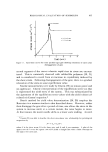
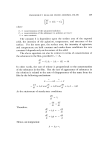
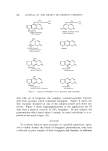
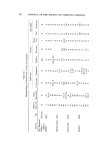
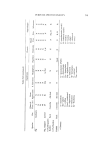
INGREDIENT RELEASE FROM AEROSOL FILMS 669 • here C• = concentration of the saturated solution Gt = concentration of the substance in solution at time t k = rate constant. The constant k is dependent upon the surface area of the exposed solid, the intensity of the agitation, temperature, and structure of the surface. For the most part, the surface area, the intensity of agitation, and temperature are held constant and under these conditions the rate constant k depends only on the nature of the solid. The above equation can also be written in terms of concentration of the substance in the film, provided C8 -- A0 #C dt In other words, the rate of release is proportional to the concentration of the substance in the film. But the rate of appearance of substance in the solution is related to the rate of disappearance of the same from the film by the following mechanism: k• A •B •C dA dC dB dt - klA and d•- = ko.B and di- = klA -- k2B At the attainment of steady state conditions dB dt = O, dA dC -- dt dt dC dA - k.4 - dt dt dC dA -- = kdt = A A Therefore, Hence, on integration' A = Aoe--kt•

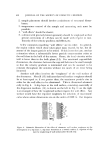
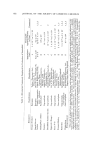
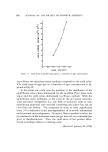
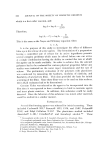
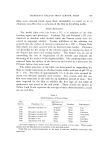
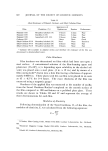
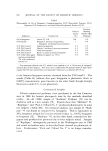
670 JOURNAL OF THE SOCIETY OF COSMETIC CHEMISTS which is a first order reaction, and kt log A = log A0 -- •.303 Therefore, kt log (A0 -- Ct) = log A0 2.303 This is the same as the Noyes and Whitney equation when C• = A0 It is the purpose of this study to investigate the effect of different films upen the release of active agents. The formulation of a preparation having a controlled rate of release [or its active in•edients presents several complex problems which must be solved be[ore one can arrive at a single combination having the ability to control the rate at which the agents can be made available. In order to achieve this, the selected polymers had to be evaluated for various physical properties before any studies were initiated on the water vapor transmission and the rate of release. The preliminary evaluation of the polymers with plasticizers was conducted by measuring the hardness, modulus of elasticity, and flexibility of several test films. This data provided the basis for initial screening of the films. Since these films were to be used on skin surfaces, their alkali resistance had to be determined. Gentian Violet was selected as the agent to be incorporated into the film since it was reported to have a tendency to bind to nonionic agents and inert plastic matrices. In addition, this substance could be easily detected. Once the behavior of this substance was noted, other materials could be studied in a similar manner. EXPERIMENTAL Several film-forming agents were selected for initial screening. These included Carboset© 525,* Emerez© 1533, 1536, and 15407 Polymid© 1155,* and Ethyl Cellulose N-10.• The plasticizers studied included Anierchol© L-101,II Citroflex©-4? and hexadecyl alcohol.** These * Tl•crmoplastic acrylic resin, B. F. Goodrich Chemical Co., Cleveland, Ohio. '• Thermoplastic polyamide resin, Emery Industries, Inc., Cincinnati, Ohio. :• rl'hcrmoplastic polyamide resin, Lawter Chemicals, Inc., Krumbhaar Resin Div., Chicago. õ Hercules Powder Co., Wilmington, Del. I[ Lanolin derivative, American Cholestrol Products, Inc., Edison, N.J. ô Trihutyl titrate, Pfizer & Co., Inc., New York, N.Y. ** Enjay Chemical Co., Elizabeth, N.J.
Purchased for the exclusive use of nofirst nolast (unknown)
From: SCC Media Library & Resource Center (library.scconline.org)