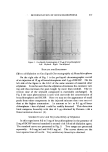
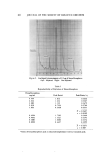
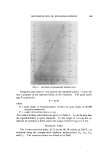
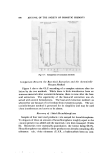
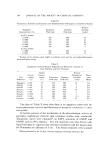
684 .JOURNAL OF THE SOCIETY OF COSMETIC CHEMISTS ('hanging in ultraviolet absorption between these pH's do not interfere providing their absorption is not so great that measurements cannot be readily made. This was the problem faced by the present authors in analyses of hexachlorophene. In the same year, Porcaro and Shubiak published a GLC method for this substance (3). They used a very short column (to minimize re- tention) heavily loaded with UC W 98 silicone. An electron capture detector was used because of the extreme sensitivity it afforded. In an earlier paper, Porcaro reported that with a flame ionization detector, a detection limit of about 5 t•g was obtained (4). Because of the complex mixtures under investigation in the present study, it was found advisable to use much longer columns to obtain good separation. Because of the very high concentration of hydroxyl coin- pounds relative to that of hexachlorophene in cosmetic formulations, a flame ionization detector was preferred. Oxygenated compounds are readily detected by electron capture, and their presence seriously re- duces detector sensitivity. Further, electron capture detectors are readily contaminated, requiring the use of prolonged treatment to eliminate the contamination (3). Wisniewski (5) reported a GLC method in which hexachlorophene is first extracted from soap by acetone. This method of isolating the com- pound is impractical in most other cosmetic preparations because of the presence of large amounts of interfering substances. EXPERIMENTAL Reagents and Equipment Specific reagents used were hexachlorophene,* dicyclohexylphthalate (DCHP),* and, as silylating agent, Tri-Sil BSA©* (Cat. No. 490107). All other chemicals were of analytical reagent grade. Equipment included silylation vials,* Cat. No. 13028-A, or similar containers, and septumsll (Cat. No. F-138, 0.5 in. in diameter). These septurns are used to cap the sily]ation vials with the Teflon©• coating * Sinda• ' C, orp., 321 42 St., New York, N.Y. 10017. ? K and K l,aboratories, 121 Exprcss St., Plainview, N.Y. 11803. $ Pierce Chem. Co., P.O. Box 117, Rockford, Ill. 61105. I I Canton Bio-Mcdical Proflucts, P.O. Box 154, Swarthmore, Pa. 19081. ô E. I. du Pont de Nemours, Wilmington, Del.

DEq'ERNIINATION OF HEXACHLOROPHENE 685 facing the contents. These are also used to cap injection ports to eli•ni- nate spurious peaks at high temperatures. The gas-liquid chromatograph * was equipped with a flame ioniza- tion detector. The column, 5 ft. X 0.25 in. aluminum, contained 5% SE-30 on acid-washed, DMCS-treated Chromosorb W (60/80 mesh). The column was programmed from 200øC up at 6øC/minute. Helium carrier flow was 60 ml/min. Methods Silylation and Gas-Liquid Chromatography A solution containing 10 mg or less of hexachlorophene in either acetonitrile or dichloromethane is obtained by isolation from the product (see isolation methods). This solution is evaporated in a silylation vial to dryness at 40ø-60øC in a stream of nitrogen. When the amount of sample is below I rag, 1.0 ml of a 0.02% DCHP solution in methanol is added to the silylation vial. When the amount of sample exceeds 1 mg, 1.0 ml of a 0.2% of DCHP is added. After the methanol is evaporated in a stream of nitrogen, silylation is accomplished by adding 1.0 ml of Tri-Sil BSA with a hypodermic syringe and needle through the septurn of the silylation vial. Reaction is immediate and 2.0 t•l of the resulting solution •nay be injected into the GI,C column under the conditions given above. Isolation of Hexachlorophene prior to Silylation Base-Acid Extraction--A sample equivalent to 10 mg or less of hexa- chlorophene is accurately weighed into a 125-ml separatory funnel con- taining 50 ml of benzene. The benzene solution is extracted twice with 50 ml of water. After separation, the water layer is discarded. Extrac- tion is carried out three times with 25-ml, 10-ml, and 10-ml aliquots of 1N sodium hydroxide. The alkaline extracts are combined in a 125-ml separatory funnel. Three drops of methyl orange indicator are added and the solution is acidified with concentrated hydrochloric acid. This solution is then extracted with two 30-ml portions of dichloro- methane and the extracts are combined in a 125-ml Edenmeyer flask. After concentration tO approximately 2 ml on a steam bath in a gentle stream of nitrogen, the residue is transferred with the aid of a pasteur * Hewlett Packard, 1501 Page Mill Rd., Palo Alto, Calif. 94304.
Purchased for the exclusive use of nofirst nolast (unknown)
From: SCC Media Library & Resource Center (library.scconline.org)