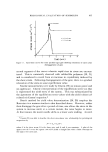
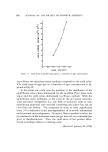
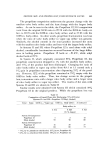
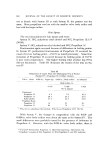
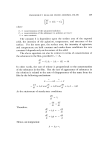
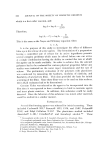
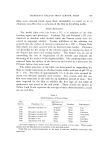
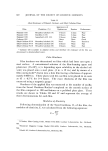
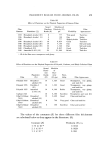
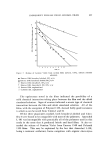
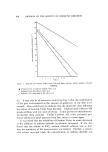
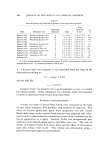
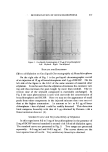
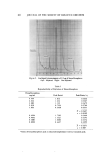
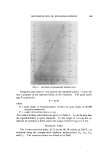
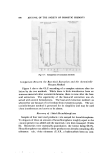
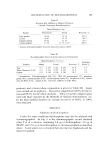
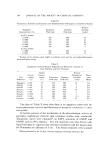
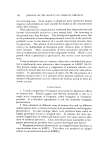
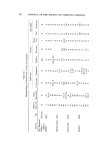
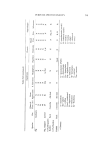
ORIFICE SIZE AND PROPELLANT/CONCENTRATE RATIO 665 a significant difference in the ethyl alcohol concentration between Sys- tems IV and V after discharging 75% of the product. In System IV, with the large valve body orifice, the ethyl alcohol content increased from 50 to 64.8%, the propellant/concentrate ratio went from 50:50 to 35.2:64.8, and the Propellant 12/11 ratio went from 50:50 to 29:71. In System V, the ethyl alcohol co.ntent increased only 3.6% and the pro- pellant/concentrate ratio changed from 50:50 to 46.4:53.6. Thus, the product still sprayed with a good pattern and was acceptable. The pro- pellant composition for 12/11/isobutane changed from 45:45' 10 to 31:60:9. CONCLUSION From these studies, it can be seen that restricting the valve body orifice increases fractionation when a vapor tap is used. Therefore, it is advisable to use a larger valve body orifice and to keep the ratio of valve body orifice to vapor tap orifice greater than 1:1. It is, therefore, recommended that the discharge rates of personal deodorants and hair sprays be reduced by restricting the actuator orifice rather than the valve body orifice. (Received February 6, 1970) REFERENCES (1) Flanner, L. T., and Matera, T. ]., Effect of vapor tap valves on propellant/conccntrate ratio, ]. Soc. Cosmet. Chem., 20, 365-72 (1969).

666 JOURNAl, OF THE SOCIETY OF COSMETIC CHEMISTS Society iof Cosmetic Chemists Announces 1970 Scholarship Grants The B()ard of Directors of the Society of Cosmetic Chemists has ap- proved 1970 scholarship grants totalling $4,300. The Society's Scholar- ship Chairman, Dr. Winthrop E. I,ange, has announced allocation to six •niversities: Purdue [Sniversity School of Pharmacy, Lafayette, Ind., Professor Glen J. Sperandio 'continuation grant of $1,000 to support the under- graduate program in cosmetics. '•Vest Virginia University School of Pharmacy, Morgantown, W. Va., Professor Paul Zanowiak continuation grant of $500 to support undergraduate seminars in cosmetics. Roosevelt University Department of Chemistry, Chicago, II1., Professor Walter S. Guth•nann continuation grant ot5 $500 for teaching equip- ment. ( olumbi'a University College of Pharmaceutical Sciences, New York, N. Y., Dean Joseph L. Kanig continuation grant of $500 for lab- oratory equipment. Northeastern University College of Pharmacy, Boston, Mass., Professor Frederick J. Pruyn new grant of $500 for graduate student assis- tance. Ilniversity of Cincinnati College of Pharmacy, Cincinnati, Ohio, Pro- fessor W. A. Ritschel new grant of $800 for partial support of a graduate student. University of Cincinnati College of Pharmacy, Cincinnati, Ohio, Pro- fessor J. Leon Lichten new grant of $500 to support the under- graduate program in cosmetics. Additional funds are available for allocation during 1970. Interested faculty members should contact Dr. Lange.
Purchased for the exclusive use of nofirst nolast (unknown)
From: SCC Media Library & Resource Center (library.scconline.org)