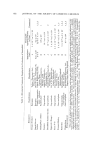
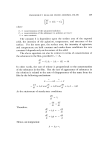
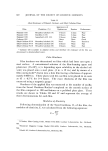
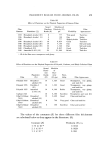
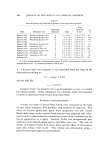
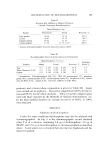
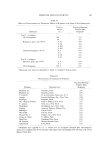
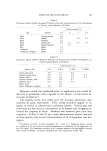
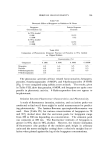
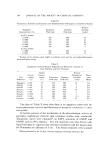
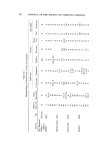
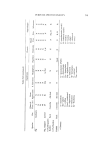
INGREDIENT RELEASE FROM AEROSOL FILMS 673 Table III Effect of Plasticizer on the Physical Properties of Emerez Films Sward Modulus of Film Hardness Elasticity (E), Film Emerez Plasticizer (%) Rocks (R) psi Flexibility Appearance" 1533 Hexadecyl alcohol (10) 8 777 Very good Tack free 1536 Hexadecyl alcohol (5) 4 100 Fair Sticky 1536 ... 8 777 Slightly brittle Tack free 1540 Hexadecyl alcohol (10) 18 8,859 Good Tack free 1540 Hexadecyl alcohol (20) 14 4,100 Fair Soft and tacky 1540 Hexadecyl alcohol (30) 10 1,520 Fair Soft and tacky 1540 Citroflex-4 (10) 18 8,859 Good Tack free 1540 Amerchol L-101 (10) 24 21,000 Brittle Tack free All of the films were transparent and glossy. Table IV Effect of Plasticizer on the Physical Properties of Polymid, Carboset, and Ethyl Cellulose Films Sward Modulus Hard- of ness Elas- Plasticizer Rocks ticity Flexi- Film (%) (R) (E), psi bility Film Appearance Polymid 1155 Hexadecyl 10 1,520 Good Transparent, very glossy, alcohol (10) and tack free Polymid 1155 Citrofiex-4 10 1,520 Good Tramparent, very glossy, (10) and tack free Polymid 1155 Amerchol 14 4,100 Brittle Transparent, very glossy, L-101 (10) and tack free Carboset 525 ... 14 4,100 Excellent Translucent and tack free Ethyl Cellulose Hexadecyl 12 2,600 Good Clear and tack free N-10 alcohol (10) Ethyl Cellulose Hexadecyl 8 700 Very good Clear and tack free N-10 alcohol (20) Ethyl Cellulose Hexadecyl 4 100 Excellent Clear and tack free N-10 alcohol (30) The values of the constants (K) for three different illin thicknesses are tabulated below as they appear in the literature (8). Constant (K) Thickness (T), in. 1.73 X 10 -9 0.0012 2.1 X 10⁻⁸ 0.0024 1.3 X 10 -7 0.004

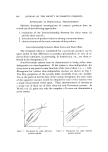
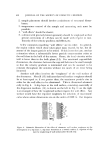
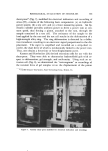
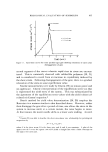
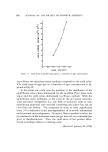
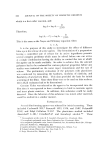
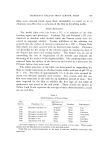
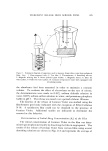
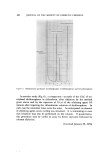
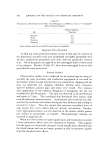
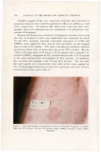
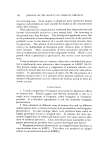
674 JOURNAL OF THE SOCIETY OF COSMETIC CHEMISTS As the film gets thinner, the precision of the measurement decreases and as the film gets thicker, the precision increases. These results are also shown in Tables III and IV. Aerosol Formulations Product concentrates were prepared by dissolving 5% w/w of the resin in the solvent previously indicated (25% w/w) with the aid of heat. Propellant 12/11 (50:50), 70% w/w, was used as the propellant system. In all cases a clear solution was produced and when sprayed, a satisfactory spray was obtained. Determination o/Release Rates Model films were prepared in a manner similar to those used for alkali resistance, except that the test substance, Gentian Violet, was incorporated into the solution of film-former. The model films, con- taining drug, were mounted on the flat head of the glass-stoppered tube using EA-40 Epoxy-Bonding agent. * This acted as a bond between the under surface of the film and the contact surface of the flat head stopper. A thin layer of the bonding agent was applied over a hard surface and the flat head of the glass-stoppered tube was gently placed on the top of it. As the tube was pulled away from the treated surface, the contact surface of the flat head picked up a thin coat of the adhering matter. Then, on pressing the flat head of the tube firmly against the specimen film, the latter adhered to the former. This unit was then allowed to cure overnight in an oven at 45 _+ 0.5øC. Finally, the periphery of the flat head was trimmed with a sharp blade to remove the excess of the film. This tube was then placed in a water-jacketed beaker containing 300 ml of desorbing solvent maintained at 37 ñ 0.5øC. The solution was agitated by means of a magnetic stirring bar. The entire assembly was then placed on a magnetic stirrer. The temperature of the desorbing solvent in the beaker was kept constant by circulating water from the constant temperature bath, equipped with stir pump, around the beaker. The apparatus is illustrated in Fig. 1. Aliquot samples of the solvent were withdrawn at various time inter- vals and analyzed spectrophotometrically at 590 mr, for the concentration of Gentian Violet present using a Coleman-Hitachi Spectrophotometer, Model 124.* The samples were then placed back into the beaker after ß SmOoth-On, Inc., Gillette, N.J. ? Coleman Instruments Corporation, Maywood, Ill.
Purchased for the exclusive use of nofirst nolast (unknown)
From: SCC Media Library & Resource Center (library.scconline.org)