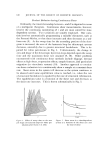
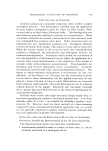
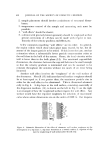
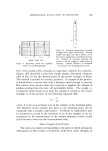
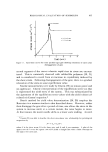
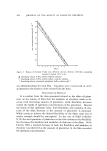
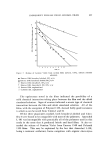
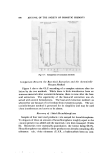
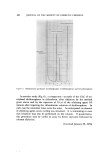
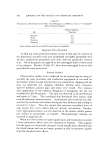
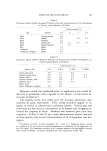
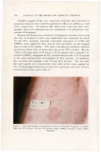
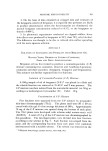
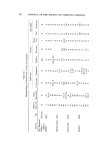
RHEOLOGICAI. EVALUATION OF SEMISOLIDS 657 Io 8 x z • 4 q• gear disengaged I I 5 lo ß 2.0 % w/w agar ß 1.0 %w/wagar I I I 15 20 25 TIME CM•N.) Figure 11. Stress-time curves for some purified agar gels showing relaxation of stress after disengagement of gear second segment of the curves wherein rapid rises in stress are encoun- tered. This is commonly observed with rubberlike polymers (30, $1) and is considered to result from an increase in crystallinity induced by the shear strain. Following disengagement of the gear, there is a gradual relaxation of the stress to some equilibrium value. Similar measurements were made by Charm (32) on tomato puree and on applesauce. Charm's interpretat. ign of the equilibrium stress was that it represented the yield stress of the system. , This was substantiated by the agreement of the equilibrium stress values with the yield values cal- culated via Casson's equation. • Bruss's method for yield value, determination (2• 29) employs the Rotovisco in a manner similar to that described above. However, rather than disengage the gear after a period of time, one allows the stress in the system to increase until, at a certain instant, the rotor begins to move. At that instant, the meter needle shifts to a lower scale reading. Accord- * Casson (33) was able to describe thc shear stress-shear rate rclationship for printing-ink suspensions by F ø'• = k o q- k•D ø-•, where F is thc shear stress, D is thc shear rate, and ko and kx are constants. A plot of the square root of F versus the square root of D yields a straight line with a finitc intercept on the square root-stress axis.

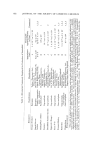
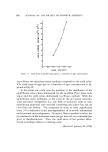
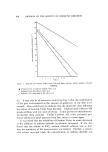
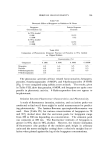
658 [OURNAL OF THE SOCIETY OF COSMETIC CHEMISTS ing to Bruss, the maximum meter reading corresponds to the yield value. The yield stress of agar gels as a function of agar concentration is de- picted in Fig. 12. At this point one could raise the question of the significance of the equilibrium stress values determined via the modified Pryce Jones tech- nique and the yield values determined via Bruss's method. With the equilibrium stress technique, as the stress in the gel system increases, some structural realignment (i.e., the shift of structural units to non- equilibrium positions) and cross-link wandering take place--but not all cross links are broken. The relaxation of stress to some equilibrium value •0 is indicative of the time-dependence of cross-link reformation and structural unit realignment. However, Bruss's method involves the determination of the maximum stress the gel network can withstand just prior to rheodestruction. Thus, the yield stress of the product deter- mined according to Bruss is a limiting value. (Received January 28, 1970)
Purchased for the exclusive use of nofirst nolast (unknown)
From: SCC Media Library & Resource Center (library.scconline.org)