J. Soc. Cosmet. Chem., 21, 667-681 (Sept. 17, 1970) The Release of Various Ingredients from Aerosols Containing Selected Film-Forming Agents JOHN J. SCIARRA, Ph.D.? and RAM GIDWANI, M.S.* Presented October 1, 1969, First Annual Joint Meeting New York Chapter Society of Cosmetic Chemists with Universities at St. John's University, College of Pharmacy, Jamaica, N.Y. Synopsis--The influcnce of selected POLYMERS and PLASTICIZERS on the rate of re- lease of GENTIAN VIOLET was investigated with the objective of assessing the nature of the binding which may take place between the substance and the polymer-plasticizer system. Gentian Violet was used as the model substance on the basis that it does exhibit binding power and that it can be easily detected. It was noted that as the polarity of the film decreased, the rate of release increased. The release of this substance from the films studied was found to follow first-order kinetics. Several of the films studied were found to give a rather rapid release of Gentian Violet indicating little, if any, complexation between the substance and the film while other films tended to inhibit or prolong the release. Certain plasticizers were found to inhibit the release of Gentian Violet while others tended to increase the release. Selected physical properties of the FILMS were studied initially in order to determine those film-plasticizers combinations which might best bc suited to application as an AEROSOL SPRAY. * Investigation supported by a grant received from the Precision Valve Corp., Yonkers, N.Y. Abstrated in part from a dissertation submitted by Ram Gidwani to the graduate faculty, St. John's University, College of Pharmacy, in partial fulfillment of the require- ments for the Master of Science deg•'ee, June, 1969. * St. John's University, College of Pharmacy, Jamaica, N.Y. 11432. $ Present address: Warner-Lambert Research Institute, Morris Plains, N.J. 667

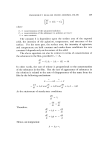
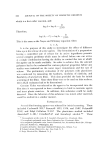
668 JOURNAL OF THE SOCIETY OF COSMETIC CHEMISTS INTRODUCTION The use of a polymeric film which is sprayed or applied to the skin can serve not only to protect the skin against the excessive loss of water but also to facilitate prolonged contact between an active in- gredient and the skin. When the film is applied in a thin protective layer as might be accomplished by a spray-on product, the active ingre- dients are released from the vehicle into the skin (1). It therefore be- comes apparent that the release of the drug will be influenced by the type of vehicle used (2). Hence, in order to treat various skin disorders with maximum effectiveness, the choice of the polymeric film becomes ex- tremely important. Further, the ability of moisture to permeate through the polymeric film allows [or an exchange of vapors so that the skin area is not hermetically sealed. Polymeric films which are electronegative in character, such as poly- amide and cellulose films, will attract and hold active agents that are positively charged and subsequently exert prolongation of release from the film (g, 4). The existence of a significant degree of interaction be- tween ionic species and nonionic sur[actants (5) very clearly demonstrates a considerable influence of the binding upon the release of substance from the formulation (6). This might be particularly true in the formu- lation of spray-on bandages where nonionic esters such as plasticizers are often employed to impart flexibility to the films. The physical and chemical properties of the deposited films are largely influenced by the type and amount of plasticizers used. Many plasticizers are high boiling point organic esters intended to be mixed with film-formers to improve flexibility so that films of well-balanced properties could be prepared. The properties that are considered im- portant in the evaluation of deposited films include water vapor trans- mission, hardness, modulus of elasticity, alkali resistance, and stability to degradation [Tom exposure to ultraviolet radiation. Since this study is concerned with the rate of release of substances from films, it might be advantageous to discuss the kinetics of this re- lease. Noyes and Whitney (7) have shown that the rate of solution of solids is directly proportional to the concentration gradient when the surface of the dissolving solid remains constant. In a study of release rates, it is assumed that as the concentration of the solute in solution increases, the concentration gradient decreases and subsequently the solution rate also decreases. According to the Noyes and Whitney equa- t ion:
Purchased for the exclusive use of nofirst nolast (unknown)
From: SCC Media Library & Resource Center (library.scconline.org)