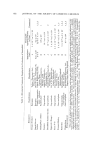
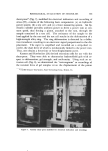
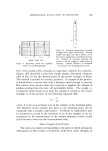
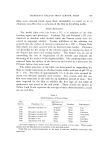
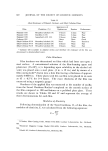
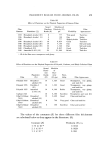
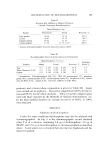
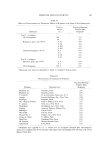
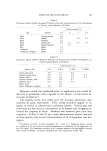
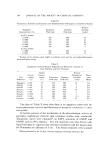
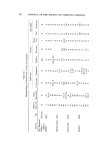
PERFUME PHOTOTOXICITY 703 Table V Phototoxic Effects (Positive Response Fraction) of Several Concentrations of Oil of Bergamot on Various Animal Species at 48 Hours Concentration (%) Site Species 10 5 1 0.5 Back Hairless mouse 2/2 Back Rabbit 2/2 Back Hamster 1/2 Back Guinea pig 4/4 Back Squirrel monkey Ear Swine 1 / 1 Abdomen Swine 1/3 Abdomen, stripped Swine 4/4 2/2 2,/2 1/1 4/5 0/5 o/1 Table VI Phototoxic Effects (Positive Response Fraction) of Several Concentrations of Bergapten on Various Animal Species at 48 Hours Concentration (%) Species, Site 0.01 0. 001 0. 0001 0. 00001 Guinea pig, back 5/6 5/7 0/4 Hairless mouse, back 2/2 5/5 3/4 Rabbit, back 6/6 3/6 0/1 Squirrel monkey, back 0/6 1/8 0/7 Hamster, back 0/3 0/3 0/3 Swine, back 0/2 Swine, abdomen, stripped 2/2 2/2 0/3 o/1 Bergamot which was irradiated prior to application was found in- effective in producing a skin response in the absence of concurrent ul- traviolet irradiation.* - The hairless mouse and rabbit gave the strongest phototoxic skin reactions by gross observation. They would therefore appear to be species of choice in phototoxicity screening studies. Guinea pig and swine skin was less reactive nevertheless, as in human skin, stripping en- hanced the response in swine. Monkeys and hamsters gave poor skin responses. Tables V and VI give some phototoxicity results obtained on these species with several concentrations of oil of bergamot and ber- gapten. * Irradiation of 0.02% alcoholic bergapten for 1 hour in a stoppered quartz cuvette at a distance of 2.5 cm resulted in photodecomposition, as indicated by the appearance of five TLC spots. The phototoxic capacity of the resultant solution was only slightly reduced when tested on rabbits. Irradiation photolysis has been reported by others (13).

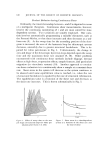
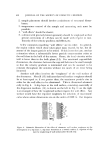
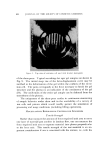
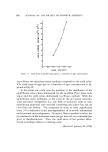
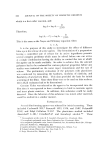
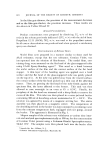
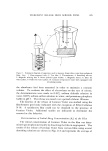
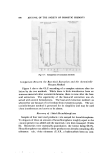
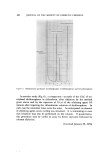
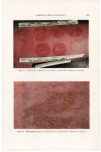
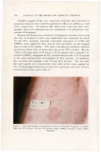
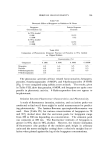
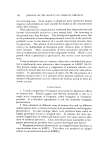
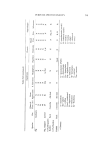
701 .JOURNAL OF THE SOCIETY OF GOS\IETIC CHEX, IlS-lb Purified samples of the two couxnarins, limettin and 7-methoxy-5- gcranoxycoumarin, were tested for phototoxic effects in tabhits at l and 0.5%, respectively. No adverse skin effects were observed, and conse- quently, these two coumarins are not considered to be phototoxic com- ponents of bergamot. Because the tluorescence intensity of bergapten soh•tions varic• with the ratio of alcohol to water, one experiment was conducted in which 70 and 95% alcoholic solutions containing bergapten at 0.008 aud 0.0008% were applied to four sites in close proximity on the clipped back of each of 12 rabbits. The more concentrated alcoholi, solution spread over ahout twice as much skin area as the 705/0 alcohol. Results (Table VII) show that at 24 hours, 9 of 12 animals gave a positive re- action to 0.0008% hergapten in 70% alcohol whereas only 5 of 12 reacted to the salne concentration of bergapten in 95% alcohol. In addition, the reactions were stronger with 70 than 95% alcohol. The fact that the agent spread over considerably more skin surface when applied in 95% alcohol suggests that there is less active agent per trait area, thereby accounting for these results (Fig. •). Figure 4. Area and intensit• of phototoxic reactions to alcoholic bergapten in rabbits. Riglit side, 95% alcohol left side, 70% alcohol upper, 0.0008% bergapten lower, 0.008% bergapten
Purchased for the exclusive use of nofirst nolast (unknown)
From: SCC Media Library & Resource Center (library.scconline.org)