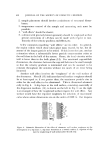
RHEOLOGICAL EVALUATION OF SEMISOLIDS 649 Static Structure of Semisolids Cosmetic products of a semisolid consistency often exhibit complex theological behavior. The deformation resulting from the application of stress seldom corresponds to that for either an ideal viscous (New- tonian) body or an ideal elastic (Hookean) body. The rheologically non- ideal behavior generally exhibited is referred to as viscoelasticity. When viscoelastic semisolids are stressed, a deformation of some structural units into nonequilibrium positions takes place. Other structural units are fieformed into new equilibrium positions (11). Viscoelastic behavior involves deviations from ideality with respect to time and/or stress (12). When the relative motion of the structural units into nonequilibrium positions is hampered, the deformation and subsequent recovery are rendered time-dependent. Techniques which permit the elucidation of the time-dependence of deformation involve either the application of a constant stress (creep measurements) or the subjection of the sample to constant strain (stress-relaxation measurements). Time-dependent de- formation and recovery characterize linear viscoelasticity. Nonlinear viscoelasticity involves both time- and stress-dependent behavior. The degree to which nonlinear viscoelasticity is encountered can vary con- siderably. As Van Wazer et al. (13) point out, the relationship between viscous and/or elastic deformation and the applied stress may be con- sidered a linear function as long as small deformations are incurred. •Vith relatively rigid materials, only small deformations can be achieved without fracture of the sample. Relatively soft viscoelastic materials show a greater departure from !inearity as the extent of deformation be- comes greater and greater. Methods which involve only slight structural change would elicit in- formation regarding the product's theological ground state. Low shear methods, where D 1 sec -•, are suitable for studying a product's static structure (2). However, most low shear methods are time-consuming compared to more conventional theological approaches and, as a result, are not generally employed in quality control programs although they may have application in product development. INSTRUMENTATION FOR THE RHEOLOGICAL EVALUATION OF SEMISOLIDS Rheometers Suitable [or Determination of the r-D Interrelationship The following factors need to be taken into consideration: 1. measurements should be made at a variety of shear rates, i.e., the in- strument used must be a multipoint device

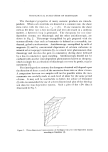
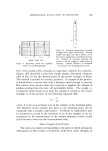
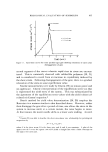
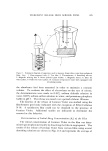
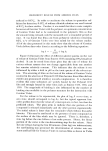
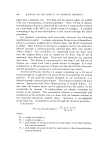
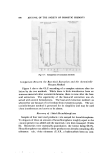
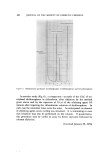
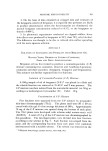
650 JOURNAL OF THE SOCIETY OF COSMETIC CHEMISTS 2. sample placement should involve a minimum of structural distur- bance 3. temperature control of the sample and measuring unit must be possible 4. "wall effects" should be absent 5. a device with precisely known geometry should be employed so that precise corrections of r-D data can be made with respect to non- linearity of the velocity gradient, end effects, etc. A few comments regarding "wall effects" are in order. In general, the region within which shear takes place must exceed, by far, the di- ameter of the largest particle to be tested. If this is not the case, one has a situation where a substantially lower particle concentration exists at the wall than in the bulk of the system. Hence, the local viscosity at the wall is lower than in the bulk phase (14). For rotational cup-and-bob rheometers, the clearance between the cup and bob must be small enough so that the velocity gradient is minimized and can be assumed to be constant throughout the annulus without too much of an error being incurred. Another wall effect involves the "roughness" of the wall surface of the rheometer. Merrill (15) indicates that wall surface roughness should be at least equal to, if not greater than, the maximum particle size in order for the wall effect to be eliminated. This is illustrated schemati- cally in Fig. 6. A slip layer at the wall surface, consisting essentially of the dispersion medium (14), is shown on the left in Fig-. 6 on the right is an example of how the roughened surface negates the wall effect. Any surface would have the requisite roughness for solutions of macromole- cules where solute dimensions are on the order of 1000 •. For disperse iiili WA L t ¸ / 2 Figure 6. Schematic illustration of the effect of rheometer wall surface toughness on the development of a slip layer: 1, slip layer formation at a smooth surface 2, negation of slip layer by roughening of wall surface [after Merrill (15)]
Purchased for the exclusive use of nofirst nolast (unknown)
From: SCC Media Library & Resource Center (library.scconline.org)