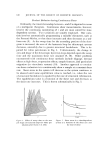
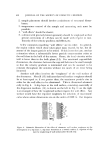
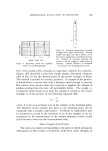
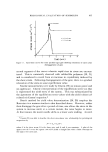
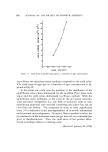
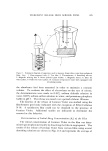
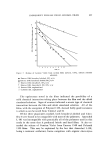
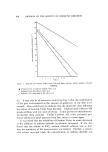
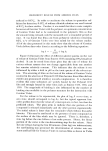
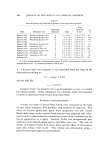
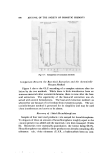
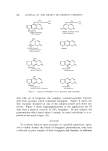
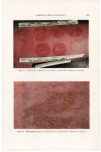
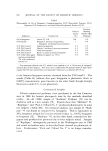
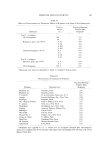
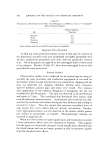
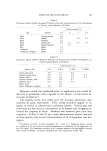
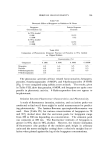
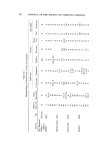
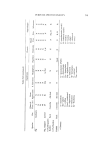
PERFUME PHOTOTOXICITY 709 4. On the basis of data obtained on stripped skin and estimates of the bergapten content of bergamot, it is expected that perfumes are likely to produce phototoxicity unless the furocoumarins are eliminated, the natural bergamot concentration reduced to 0.3%, or the bergapten re- duced to 0.001 5. In phototoxic experiments conducted on clipped rabbits, fewer skin effects were produced by bergapten in 955o than 705• ethyl alcohol. The difference was thought to be due to reduced skin surface spreading with the more aqueous solution. APPENDIX I ISOLATION OF COUMARINS AND PSORALENS FROM PgERGAMOT OIL RONALD YATES, DIVISION OF COLORS & COSMETICS, FOOD AND DRUG ADMINISTRATION Bergamot oil was first treated to produce a coumarin-psoralen (C-P) mixture containing two coumarins (limettin and 7-methoxy-5-geranoxy- coumarin) and three psoralens (bergapten, bergaptol, and bergamottin). This mixture was further separated into five fractions. Isolation of Coumarin-Psoralen (C-P) Mixture A 450-g sample of oil o.f bergamot (N.F.)* was placed in a•flask and the volatile fraction was removed at 35-65øC and 2 mm pressure. The C-P mixture was then isolated from the nonvolatile material (ca. 50 g) ac- cording to a method given by Guenther (21). Yield: 10 g. Fractionation of C-P Mixture Five fractions were separated from the C-P mixture by preparative thin-layer chromatography (TLC). The plates used were 20 X 20 cm coated with silica gel G of an average thickness of 500 v. Approximately 70 mg of the C-P mixture was spotted along the bottom of each plate. The TLC plates were developed with toluene-ethyl acetate-acetic acid (80:20:2). A total of 1.5 g of the C-P mixture was chromatographed by this procedure. The developed plates were divided into four fractions according to the scheme in Fig. 5. Each fraction was scraped from the plate, and the corresponding fractions from each plate were combined and extracted with a suitable solvent. The solvent was removed on the * Obtained from George Lueders and Co., New York, N.Y.

710 JOURNAL OF THE SOCIETY OF COSMETIC CHEMISTS SOLVENT FRONT _•_ FRAC 1 ...........
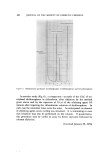
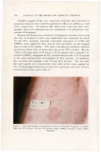
Bergomomn 7-MethoxytS-gemnoxy FRAC 2 L,mettm- __•?_, FRAC 3 6 or more 1 "repounds FRAC 4 ORIGIN Figure 5. TLC chromatogram of psoralen-coumarin mixture steam bath and each isolated fraction was rechromatographed as described above. Each fraction was then spotted on an analytical TLC plate and developed. The plate was then examined under UV light to estimate the purity of each fraction. Fraction/--Fraction 1, when first isolated, weighed 640 mõ and solidi- fied upon standing. The solid material was dissolved in an excess of hot methanol and cooled. Crystalline bergamottin was removed by filtration (ca. 400 mg) and discarded. The mother liquor was con- centrated and spotted on preparative TLC plates in 50-mg portions and developed. Fraction 1 was recovered from the plates as above 220 mg of crystalline material was obtained. Analytical TLC showed that Fraction 1 was primarily bergamottin with a small amount ot• methoxygeranoxy- coumarin (est. 1% or less). Fraction 2--Fraction 2 amounted to 29 mg. Analytical TLC indi- cated this fraction to consist of methoxygeranoxycoumarin plus an un- identified material with a deep blue, faint fluorescence. Fraction 3--Fraction g consisted of 75 mg of a mixture of limettin and bergapten. Fraction 4--Fraction 4 consisted of all compounds present from Fraction g to the origin of the chromatogram. None of these compounds, with the exception of bergaptol, have been identified. After Fraction 4 was rechromatographed, 20 mg of material was obtained. Analytical TLC of this material showed complete absence of any of the three pre- vious fractions.
Purchased for the exclusive use of nofirst nolast (unknown)
From: SCC Media Library & Resource Center (library.scconline.org)