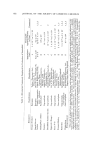
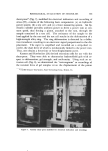
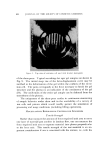
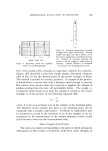
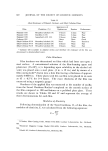
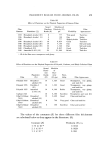
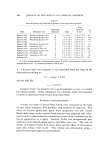
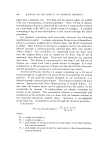
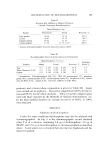
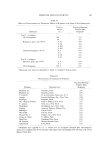
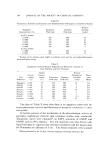
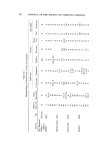
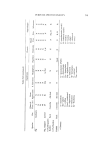
RHEOLOGICAL EVALUATION OF SEMISOLIDS 651 systems in which particles are much greater in size, surface roughness should be a design consideration. In fact, ribbed or roughened bobs have been recommended to avoid wall effects (1, 15-17) and are necessary if valid rheo•ams are to be obtained for semisolids. A very wide range of rheometers has been employed for the accretion of T-D data. Some of the rheometers more commonly employed in the cosmetic, pharmaceutical, and food industries are listed in Table I along with pertinent comments regarding their versatility. Rheometers j•or Continuous Shear Rheometry The suitability of a particular rheometer depends upon whether one is continuously varying the shear rate or one is shearing the sample at a constant rate of shear. If the shear rate varies with time, some sort of automatic programming unit should be employed. One should make certain that acceleration and deceleration are constant for the rotating member. Barry and Shotton (18) noted a considerable deviation from linearity for the incremental increase and decrease in shear rate with the Ferranti-Shirley such that if comparisons of product behavior were to be made, or if different instruments were to be used, the results would be subject to question unless the variations in shear rate increase or de- crease were known. Sample shear at a constant rate necessitates the use of rheometers with well-defined geometry. oevaluation of the Static Structure The viscoelastic behavior of semisolids has been the subject of much attention recently. Wood et al. (1) and Sherman (2) commented on some instrumental approaches to the measurement of viscoelastic defor- mation. More recently, Warburton and Barry (19) and Davis (20, 21) have employed a concentric cylinder modification of the Weissenberg Rheogoniometer which was suitable for creep measurements of oint- ments and creams. Barry and Warburton (12) have described a test method for semisolids which involves little more than the measurement of the penetration of a hard, incompressible sphere into the plane, hori- zontal surface of the product. This method would seem admirably suited for quality control and deserves further investigation. The Kramer Shear-Press In 1950, the shear-press was introduced by Kramer (22) as a means of evaluating the texture and quality of food products. The Kramer

652 JOURNAL OF THE SOCIETY OF COSMETIC CHEMISTS o• o o o o ¾
Purchased for the exclusive use of nofirst nolast (unknown)
From: SCC Media Library & Resource Center (library.scconline.org)