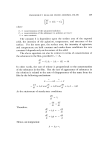
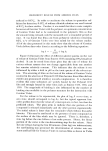
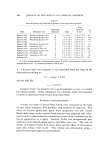
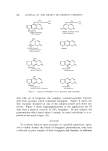
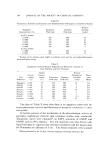
686 JOURNAL OF THE SOCIETY OF COSMETIC CHEMISTS pipet into a silylation vial. The flask and the pasteur pipet are washed with two 1-ml portions of dichloromethane. Next, 1.0 ml of dicyclo- hexylphthalate solution is added and the solution is evaporated to dryness on a sand bath at 40ø-60øC in a gentle stream of nitrogen. A standard containing 6 mg of hexachlorophene is also carried through the above procedure. For products containing solid particulate material, the following modification is useful: A sample containing 10 mg or less of hexachloro- phene is accurately weighed into a 150-ml beaker and 50 ml of methanol is added. After 0.5 hour of stirring on a magnetic stirrer, the solution is filtered through a medium-porosity sintered glass filter into another 150-ml beaker. The insolubles are transferred from the filter back into the original beaker and are mixed for 0.5 hour with 25 ml of methanol, then filtered again. Extraction and filtration are repeated once more. The flitrate is concentrated to less than 5 ml, but not to dryness, on a steam bath with a gentle stream of nitrogen. It is then transferred to a 125-ml separatory funnel with the aid of 50 ml of benzene, and the procedure is continued as with the benzene layer above. Acetonitrile-Hexane Method--A sample containing up to 10 mg of hexachlorophene is agitated with about 60 ml of acetonitrile for several minutes. If any material remains insoluble in the acetonitrile, it is filtered through a sintered glass funnel. The funnel is washed with more solvent. Extraction with three 50-ml portions of hexane follows. To save time, the hexane layers can be aspirated from the surface of the acetonitrile by vacuum. If hydrocarbons are absent, extraction by hexane is not needed. The acetonitrile solution is concentrated and transferred to the silylation vial as is done with the benzene solution in the base-acid extraction method above. Silylation is accomplished in the same way. A standard is carried through the identical procedure. Calculations-- Per cent hexachlorophene = where: 14/• = weight of standard, g 14/,• = weight of sample, g R• W•X R. X 100 = peak height of standard divided by peak height of dicyclohexylphtha- late internal standard = peak height of sample divided by peak height of dicyclohexylphthalate internal standard

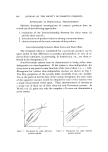
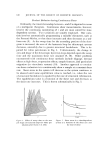
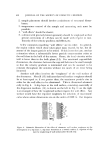
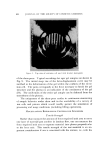
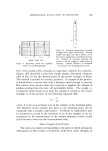
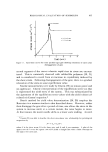
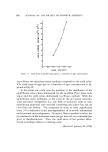
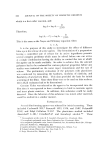
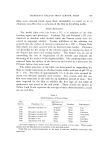
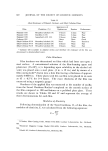
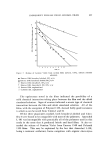
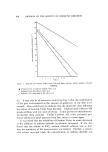
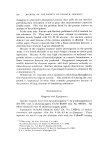
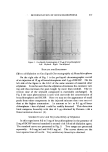
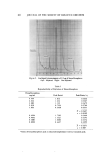
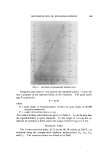
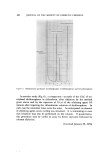
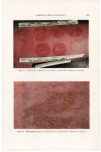
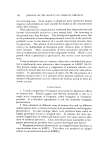
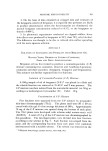
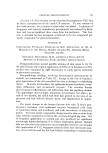
DETERMINATION OF HEXACHLOROPHENE 687 lrigu. re 1. Gas-liquid chromatogram of 12 t•g of hexachlorophene Le[t: Silylated. Right: Not silylated RESULTS AND DISCUSSION Effects o[ Silylation on Gas-Liquid Chromatography o[ Hexachlorophene On the right side of Fig. I is the gas-liquid chromatographic record of an injection of 12 vg of hexachiorophene and 4 vg of DCHP. On the left side of the figure is the GLC of the same amount of material after silylation. It can be seen that the silylation eliminates the extensive tail- ing and thus increases the peak height by more than tenfold. The re- tention time of the silylated compound is essentially unchanged. In Fig. 2 the same phenomenon is seen with one-tenth the concentration of hexachlorophene and DCHP. Here we may see the appearance of small peaks from other components in the injected mixture that were not evi- dent at the higher attenuation. An amount as low as 0.1 t•g of hexa- chlorophene when silylated would be readily detected. This detection limit compares favorably with that of 5 vg obtained by Porcaro with a flame ionization detector (4). Standard Curve and Reprod•tcibility o[ Silylation In this experiment 0.2 to 5 mg of hexachlorophene in the presence of 2 mg of DCHP internal standard is treated with 1.0 ml of silylation agent. The standard curves are presented in Fig. 3. Two ranges are presented separately: 0-5 mg/ml and 0-0.5 mg/ml. The curves shown are the least squares lines of best fit. Very satisfactory linearfry is obtained.
Purchased for the exclusive use of nofirst nolast (unknown)
From: SCC Media Library & Resource Center (library.scconline.org)