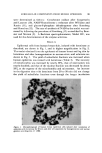
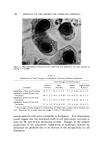
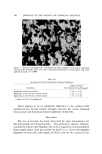
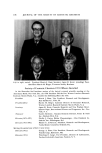
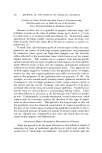
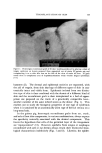
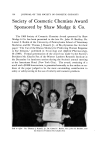
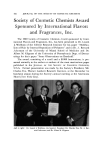
108 JOURN •,L OF 'THE SOCIETY OF COSMETIC CHEMISTS LeJt to right, seated: President Morris J. Root, Secretary Agnes R. Kortc (standing) Presi- dent-Elect Martin M. Rieger, Treasurer Stanley Brechncr Society of Cosmetic Chemists 1971 Officers Installed At the December 2nd luncheon session of the Society's annual scientific meeting at the Americana Hotel, New York City, the 1970 President Charles Fox, •Varner Lambert Research Institute, Morris Plains, N. J., installed the following officers for 1971: President Morris J. Root, Vice President, Research and Development, Barr-Stalfort Co., Niles, Ill. President-Elect Martin M. Rieger, Associate Director of Chemical Research, XYarner Lambert Research Institute, Morris Plains, N. J. Secretary Agnes R. Korte, Cosmetic Research and New Product Devel- opment Dept., International Flavors and Fragrances, Inc., New York, N. Y. Treasurer Stanley Brechncr, Associate Research Director, Foster D. Snell Inc., Florham Park, N.J. Director (1971-1972) Phyllis J. Carter, Editor Chemmuniquc, Atlas Chemical In- dustries, Inc., %qlmington, Del. Director (1971-1972) Maison G. deNavarre, President, Research and Development, Vanda Beauty Counselor, Orlando, l?la. Serving the second year of their 2-year terms: Director (1971) George A. Fioto, Vice President, Research and Development, Noxelle Corp., Baltimore, Md. Director (1971) Winthrop E. Lange, Vice President, Director of Laboratories, Purdue Frederick & Associates, Yonkers, N.Y.

J. Soc. Cosmet. Chem., 22, 109-118 (Feb. 4, 1971) Transplantation of Skin to Unnatural Sites as a Means of Studying Its Regional Differences R. E. BILLINGHAM, Ph. D3 Presented May 26-27, 1970, New York City Synopsis--HETEROTOPIC and other SKIN GRAFTING experiments, carried out on adult laboratory RODENTS, indicate that the germinal cells in the basal layer of many struc- rurally and functionally distinctive types of epidermis are equipotential. Their characteris- tic D1FFERENTIATIVE BEHAVIOR is determined by interaction with the particular type of dermis that forms their normal substrate. However, there are some exceptions which include the epidermis of tongue, cornea, esophagus, and hamster's cheek pouch, whose specificities are intrinsically maintained. They conserve their original specificity even when caused to grow on anatomically unnatural types of mesenchymal tissue bed. INTRODUCTION One of the central problems in the biology of skin is to account for the origin and maintenance throughout life of the tremendous variety of structural and functional diversity displayed by epidermis (1, 2). There are many different kinds of superficial epidermis, ranging from the ex- quisitely transparent, highly sensitive epidermis of the cornea, to the thick, tough, and relatively insensitive epidermis of the sole of foot. In addition, there is a fantastic range of epidermal appendages which in- clude hairs of functionally and anatomically different types, nails and claws, and hard scales. Finally, there is a multiplicity of types of func- * Some of the work described in this article was supported by U. S. Public Health Service Grant AI 07001. ? Department of Medical Genetics, University of Pennsylvania, School of Medicine, Phila- delphia, Pa. 19104. 109
Purchased for the exclusive use of nofirst nolast (unknown)
From: SCC Media Library & Resource Center (library.scconline.org)