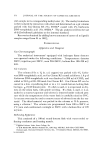
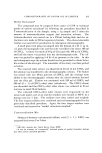
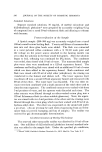
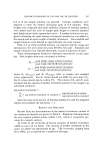
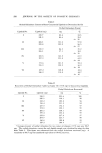
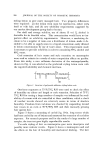
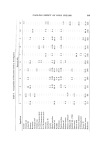
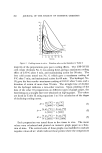
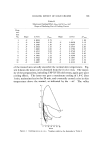
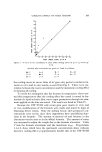
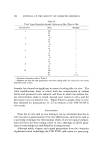
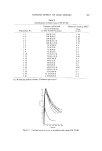
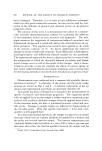
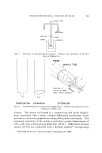
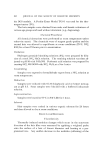
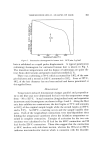
CHROMATOGRAPHY OF CASTOR OIL IN LIPSTICK 317 2-5 V1 of the sample solution was injected. Column conditions were adjusted to elute the methyl ricinoleate peak in 6-8 minutes. Peak heights were compared and whole milliliter aliquots of internal standard were added until the ratio of sample peak height to internal standard peak height most closely approached unity. A standard solution was pre- pared containing the same amount of internal standard as was added to the sample and an equal weight of methyl ricinoleate. The standard and sample solutions were diluted to approximately the same volume. Next, 2-5 tA of the standard solution was injected and the range and attenuation were set to keep the peaks 60-95% full scale. Standard and sample solutions were injected alternately, at least 2 injections of each. These chromatograms should be obtained consecutively on the same day. Peak height ratio.s were calculated as follows: R,, = peak height sample methyl ricinoleate peak height di(2-ethylhexyl) phthalate peak height standard methyl ricinoleate R• = peak height di(2-ethylhexyl)phthalate where Ru (Ru•k•ow•) and R• (Rsta•aara) refer to sample and standard ratios, respectively. The R• values should not differ by more than 5% the R• values should also be within 5%. The values of Ru and R• were averaged and the amount of methyl ricinoleate present in the sample was calculated ,as follows: mg methyl ricinoleate -- R• X mg methyl ricinoleate in standard X mg in,ternal std in sample mg internal std in standard Since the same total amount of internal standard is used for prepared sample and standard, the last factor = 1. RESULTS AND DISCUSSION Results from the determination of the methyl ricinoleate content of six commercial lipsticks are given in Table I. Replicate determinations for each lipstick yielded results within 1.5%, which is acceptable pre- cision for cosmetic analysis. In Table II the recoveries of known amounts of methyl ricinoleate added as castor oil are listed. The amount of methyl ricinoleate in the castor oil added was determined by glc. The recoveries, ranging from 94 to 100%, are acceptable for a method of this type.

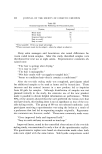
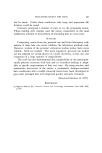
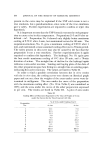
$18 JOURNAL OF THE SOCIETY OF COSMETIC CHEMISTS Table I Methyl Ricinoleate Content of Some Commercial Lipsticks as Determined by Glc Methyl Ricinoleate Found Lipstick No. Lipstick (mg) mg I 239.7 82.6 34.5 241.2 84.6 35.1 Av 35 II 265.1 151.2 57.0 229.4 129.2 56.3 Av 57 III 219.9 86.3 39.2 255.1 97.1 38.1 Av 39 IV 221.5 141.5 63.9 297.9 191.0 64.1 Av 64 V 173.6 101.3 58.4 215.9 122.9 56.9 Av 58 VI 237.2 105.8 44.6 246.2 110.0 44.7 Av 45 Table II Recoveries of Methyl Ricinoleate Added as Castor Oil (117.8 mg) to Commercial Lipsticks Methyl Ricinoleate Recovered" Lipstick No. Lipstick (mg) mg I 338.9 225.6 100 245.9 190.1 98 II 212.2 223.2 96 196.4 211.9 94 III 237.9 196.3 97 274.1 212.1 99 IV 206.5 238.1 99 199.4 233.6 99 V 232.0 237.6 97 204.9 223.7 98 VI 260.0 222.8 99 229.2 206.9 97 • Average recovery of methyl ricinoleate for two castor oil aliquots (117.8 rag) was 106.7 rag. The methyl ricinoleate content for each lipstick sample was calculated by using the data from Table I. This figure was subtracted from the methyl ricinoleate recovered (mg). A remainder of 106.7 mg was considered equivalent to 100.0 % recovery.
Purchased for the exclusive use of nofirst nolast (unknown)
From: SCC Media Library & Resource Center (library.scconline.org)