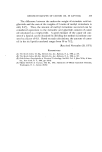
CHROMATOGRAPHY OF CASTOR OIL IN LIPSTICK 319 The difference between the molecular weight o[ ricinoleic acid tri- glyceride and the sum of the weights o[ 3 moles of methyl ricinoleate is only 0.4%. Thus, the amount o[ methyl ricinoleate recovered can be considered equivalent to the ricinoleic acid glyceride content of castor oil calculated as a triglyceride. A good estimate of ,the castor oil con- tent of a lipstick can be obtained by dividing the methyl ricinoleate con- tent by a [actor of 0.9. Based on such c,alculations, the amount o[ castor oil in the six lipsticks analyzed ranges f•om 39 to 71%. (Received November 29, 1971) REFERENCES (1) The Merck Index, 7th Ed, Merck & Co., Inc., Rahway, N.J., 1960, p. 219. (2) The Merck Index, 8th Ed., Merck & Co., Inc., R. ahway, N.J., 1968, p. 217. (3) Kirk-Othmer Encyclopedia o/ Chemical Technology, 2nd Ed., Vol. 4, John Wiley ge Sons, Inc., New York, N.Y., 1964, pp. 524•5. (4) Official Methods o/ Analysis, 10th Ed., 1965, Association of Official Amtlytical Chemists, Washington, D.C., Section 26.052.

1. Soc. Chern., 23, 321-331 (May 23, 1972) The Development of New Polyamide Resins for Easy-to-Manage Hair* R. A. BANKERT, Ph.D., H. H. ESPY, Ph.D., MARIA GRASSIE, B.S., and G. L. SCHERTZ, Ph.D.* Presented December 13, 1971, New York City Synopsis--A study of AMINOPOLYAMIDES, selected for their similarity to hair protein, shows these polymers are well adapted for the preparation of hair care RESIGNS designed to give EASILY MANAGED HAIR with improved quality. A shampoo-resistant HAIR CONDITIONER and an efficient STYLING LOTION resin have been prepared by intro- ducing reactive an,d nonreactive groups at the secondary amino nitrogen position. INTRODUCTION This paper covers a case study of laboratory experiences in the development of two types of resins to give easily managed hair that holds its position after styling. An aminopolyamide class of resins was selected for the study because of its chemical similarity to hair protein and the relative ease of changing composition to obtain desired properties. The study includes work on laboratory methods used to obtain reliable measures of product performance in a program on (a) reactive polyamides for permanently conditioning hair to give improved quality and (b) non- reactive polymers for use in styling lotions. EXPERIMENTAL AND RESULTS Shampoo-Resistant Conditioner The work on hair-reactive, shampoo-resistant polyamides for mak- ing hair easier to curl, comb, and style, and for giving improved "body" *Hercules Research Center Con, tribution No. 1579. * Hercules Incorporated, Research Center, Wilmi,ngton, Del. 19899. 321
Purchased for the exclusive use of nofirst nolast (unknown)
From: SCC Media Library & Resource Center (library.scconline.org)