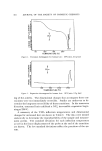
362 JOURNAL OF THE SOCIETY OF COSMETIC CHEMISTS the DCS module. A Perkin-Elmer Model TGS-1 was used for the ther- mogravimetry (TG). The hair samples were obtained from male and female volunteers of various age groups and used without alteration (e.g., degreasing). Chemical Procedures All chemical alterations were performed at room temperature unless otherwise stated. The chemicals were of reagent grade quality and the treated hair was allowed to equilibrate at room conditions (25øC, 30% RH) for at least 24 hours prior to examination. Oxidation Hydrogen peroxide bleaching solutions (6%) were prepared by dilu- tion of a stock 3070 H202solution. The resulting solution was then ad- justed to pH 10 with NH4OH. Performic acid solution was prepared by treating 88% HCOOH with 3070 H202 at a 9-to-1 ratio. Crosslinking Samples were exposed to formaldehyde vapors from a 3670 solution at room temperature. Reduction Samples were reduced with 0.1M thioglycolic acid or benzyl mercap- tan at pH 6.3. Some samples were blocked with a buffered iodoacetate solution. Supercon traction Samples were heated to 95øC in 8M LiBr for 1 hour. Solvents Hair samples were soaked in various organic solvents for 24 hours and then allowed to dry at room conditions. RESULTS AND •)ISCUSSION Viscoelasticity Thermally induced modulus changes which occur in the transverse direction of the hair fiber were measured by applying a weighted probe onto the surface of a hair of known diameter and heating at a pro- grammed rate. Any sudden decrease in the modulus (softening) of the

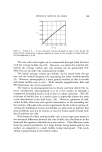
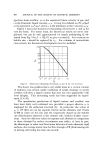
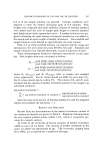
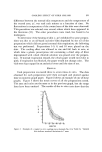
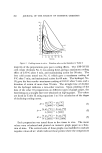
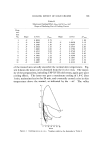
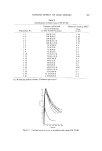
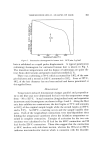
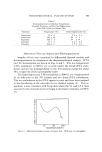
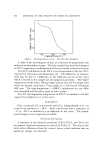
THERMOMECHANICAL ANALYSIS OF HAIR 363 I I I I 50 I00 150 200 TEMPERATURE (øC) Figure 3. Penetration thermogram for human hair: 20øC/rain, 5-g load hair is exhibited as a rapid probe displacement. A typical penetration (softening) thermogram for untreated human hair is shown in Fig. 3. The transition temperatures and the degree of softenings are quite dis- tinct from other keratin and protein materials studied (2, 3). There was a softening at 59øC which accounted for 3.0% of the sam- ple thickness and a second at 242øC amounted to 24%. Even at 327øC, 40% of the hair diameter has not been melted and hence penetrated at this applied force. Dimensional Temperature-induced dimensional changes parallel and perpendicu- lar to the fiber axis were determined for hair over the temperature range from --50 to 325øC. Actual extension (longitudinal axis) and expansion (transverse axis) thermograms are shown in Figs. 4 and 5. Along the fiber axis, hair exhibits two contractions the first begins at 72øC and amounts to 0.6% of the original sample length while the second begins at 224øC and is 2.9%. At 242øC, a melting occurs and the sample rapidly elon- gates. Both of the longitudinal contractions were time-dependent since holding the temperature anywhere above the initiation temperature re- sulted in complete contraction. Energies of activation for the two con- tractions were calculated to be 12 kcal for the 60øC contraction and 90 kcal for the 224øC contraction. These data suggest that the contraction at 60øC involves only side-chain motion, whereas the 90 kcal at 224øC indicates macromolecular motion which is consistent with the disorder-
Purchased for the exclusive use of nofirst nolast (unknown)
From: SCC Media Library & Resource Center (library.scconline.org)