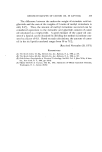
370 JOURNAL OF THE SOCIETY OF COSMETIC CHEMISTS CONCLUSIONS Thermomechanical analysis ot5 hair complements other thermoana- lyrical techniques and in many situations TMA monitors temperature- dependent properties which are not sensed by gravimetric (TG) or en- thalpic (DTA, DSC) thermal analyzers. The reproducibility of the dis- tinct viscoelastic and dimensional transitions in hair is indicative ot5 the high degree ot5 macromolecular structure ot5 hair. Since TMA probes these structures, the technique and resulting information should be of use to those involved in hair chemistry. (Received February 23, 1972) REFERENCES (1) Encyclopedia of Polymer Science and Technology, Vol. 8, John Wiley & Sons, Inc., New York, 1968, p. 1-44. (2) Humphries, W. T., and Wildnauer, R. H., Thermomechanical analysis of stratum corneum Technique, J. Invest. Dermatol., 57, 32-7 (July 1971). (3) Humphries, W. T., .and Wildnauer, R. H., Thermomechanical analysis of stratum corneum Application, Ibid., 58• 9-13 (Jan. 1972). (4) Crighton, J. s., and Happy, F., Symposium on Fibrous Proteins, Butterworths, Australia, 1967, p. 409. (5) Menefee, E., and Yee, G., Thermally induced structural changes in wool, Text. Res. J., 35, 801 (1965). (6) Schwenker, R. F., and Dusenbury, J. H., Differential thermal analysis of protein fibers, Ibid., 30, 800 (1960). (7) Crighton, J. s., Finder, W. M., and Happy, F., Int. Wool Text. Res. Conf. (4th), Inter- science, New York, 1971, p. 847. (8) Reddie, R. N., and Nich.olls, C. H., Some reactions between wool and formaldehyde, Text. Res. J., 41, 841 (1971). (9) Reddie, R. N., and Nicholls, C. H., Absorption of formaldehyde by wool, Ibid., 41, 303 (1971). (10) Deem, D. E., and Rieger, M. M., Mechanical hysteresis of chemically modified hair, ]. Soc. Cosmet. Chem., 19, 410 (1968). (11) Felix, D. W., McDowall, M. A., and Eyring, H., The differential thermal analysis of nat- ural and modified wool and mohair, Text. Res. ]., 33, 465 (1963).
Purchased for the exclusive use of nofirst nolast (unknown)
From: SCC Media Library & Resource Center (library.scconline.org)