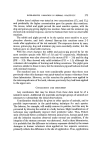
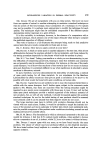
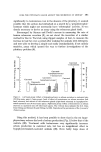
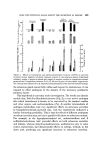
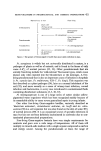
DOES THE PITUITARY GLAND AFFECT THE SECRETION OF SEBUM? 395 significantly to testosterone even in the absence of the pituitary, it seemed possible that the authors had embarked on a search for a 'preputiotrophic' hormone which might not necessarily have 'sebotrophic' activity. It was clearly necessary to devise an assay using the sebaceous gland itself. Encouraged by Strauss and Pochi's success in measuring the rate of human sebaceous secretion (3), we set about the invention of a similar method for the rat. We tried, using clipped samples of hair, to measure the increase in hair fat over a period after washing the animals with detergent, and were able to develop a simple and easily standardizable, if not unduly sensitive, assay which opened the way to further investigations of the pituitary problem (6). 1.5 Castrated q,testosterone Castrated- hypophysectomized q,testosterone Castrated q- Castrated hypophysectomized T • Castrated q, hypophysectornized - 50 Castrated 40 •' 30 'g 20 • 10 -•. o --I o o Figure 1. Left hand group: Effect of hypophysectomy on sebum secretion in castrated rats (12 litter-mate pairs.) Centre group: Lack of effect of testosterone on sebum secretion (left hand columns) and mitosis in the sebaceous glands (right hand columns) in hypophysecto- mized-castrated rats (9 litter-mate pairs). Right hand group: Effect of testosterone on sebum secretion in castrated rats (10 litter-mate pairs). The vertical lines indicate the S.E. Data from Ebling and Skinner (6) and Ebling et al (20). Reproduced by permission of the Journal of Endocrinology. Using this method, it has been possible to show that in the rat hypo- physectomy reduces the level of sebum production (Fig. 1) below that of the castrate (20). Treatment with testosterone very significantly increases sebum production in castrated rats, but has an insignificant effect in hypophysectomized-castrated animals (20). Even fairly large doses of

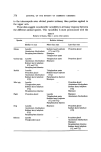
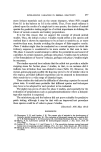
396 JOURNAL OF THE SOCIETY OF COSMETIC CHEMISTS testosterone, of the order of 0.6-1.0 mg day -•, do not produce significant increases in sebum secretion {21). These results appear, therefore, to con- firm our initial conclusions about the effect of hypophysectomy on the response of the sebaceous glands to testosterone, and to substantiate the view that a pituitary hormone must be involved as a permissive factor. That the sebaceous glands of hypophysectomized rats are unresponsive to testosterone has, however, been questioned by two other groups of workers. Nikkari and Valavaara (22) treated hypophysectomized female rats with testosterone propionate and estimated the skin lipids by washing each whole animal at 2-day intervals with acetone. Although the authors' conclusion that 0.2 mg day -• of testosterone propionate had an effect on sebum secretion appears questionable because it depends on making cor- rections for body weight, which was very much reduced in the hypophy- sectomized rats, they clearly demonstrated that a dose of 1 mg day- • given between 7 and 10 weeks of age was able to increase skin surface lipid pro- duction in hypophysectomized animals, albeit to a level no higher than that of untreated intact female rats. The same authors recently again obtained a significant increase, of the order of 160%, in sebum production when 1 mg of testosterone propionate per 4 days was given to 12-week-old hypophy- sectomized female rats (23). Thody and Shuster (24), who similarly measure total surface fat by dipping the whole animal in lipid solvents (25-27), also claim that the sebaceous gland remains sensitive to testosterone after hypophysectomy. With a dose equivalent to 1 mg of testosterone propionate per day they were able to demonstrate an increase in sebum secretion of about 270%. To summarize: there appears to be a contradiction, two groups stressing the necessity of the pituitary, and two others believing that the sebaceous gland can react to testosterone even in its absence. What could be the explanation of these differences in view? The experiments of Nikkari and Valavaara (22, 23) in which rats were hypophysectomized by the transauricular route at 3-4 weeks of age differ from those of Ebling et al (20, 21) in which hypophysectomy was carried out by a parapharyngeal route. However, Thody and Shuster (24) also used a parapharyngeal approach to hypophysectomy, which was carried out at 7-10 weeks of age. A further difference between the experiments was that Nikkari and Valavaara (22, 23) and Thody and Shuster (24) administered testosterone propionate in oil whereas Ebling et al (20, 21) used testosterone as an implant. The possible differences between the responses to testo- sterone and testosterone propionate have not yet been fully investigated,
Purchased for the exclusive use of nofirst nolast (unknown)
From: SCC Media Library & Resource Center (library.scconline.org)