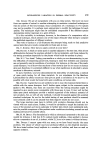
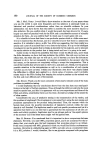
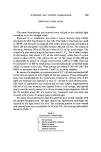
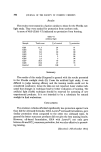
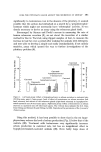
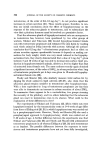
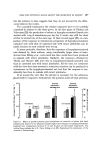
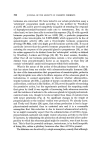
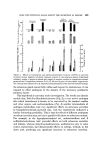
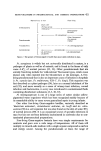
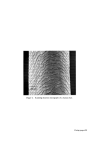
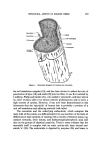
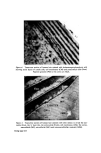
Figure 4. Transverse section of human hair stained with dodecatungstophosphoric acid showing seven layers of cuticle cells, cell membranes (CM) and paracortical cells (Para). Pigment granules (PG) in the cortex are black. Figure 5. Transverse section of human hair stained with silver nitrate to reveal the cxo- cuticle (Exo), the 'a' layer (A), the endocuticle (Endo), cell membranes (CM), the cortex, macrofibrils (MF), microfibrils (MiF) and intermacrofibrillar material (IMM). Facing page 435

STRUCTURAL ASPECTS OF KERATIN FIBRES 435 notable difference between human hair and wool, apart from the diameter of the fibre, is that human hair (Caucasian) is bounded by a layer of usually six to eight cuticle cells (Figs. 4 and 5), whereas in wool the cuticle is only one to two cells thick. The greater resistance of human hair to chemical attack by many reagents is at least partly due to the thickness of the cuticu- lar layer. Caucasian hair consists of a core of cortical cells mainly of the 'para-type', sometimes surrounded by one to two layers of 'ortho-type' cells (49). However, human hair does not show the same degree of bilateral segmentation as wool. Like wool, human hair is occasionally medullated. Infra-red spectroscopic studies of human hair suggest that the cuticle is made up of the (z and • structures of polypeptide material, while the cortex is composed of both these configurations plus the random coil or amorphous form (50). It is interesting that Negro hair contains a higher proportion of 'ortho- type' cortical cells than Caucasian hair. Also, whereas the cuticle of Caucasian hair is usually six to eight layers thick and covers the whole of each fibre, the cuticle of Negro hair is of variable thickness with six to eight layers at the ends of the major axis of the fibres and diminishing to one to two layers at the ends of the minor axis. Thus, the Caucasian hair approxi- mates to a cylinder, the Negro hair to a twisted oval rod. Negro hair is typically heavily pigmented. By means of the electron microscope, Swift (51) has measured the size of isolated melanin granules and found those from Negro hair to be larger than those from Caucasian and Chinese hair. However, no significant differences in the chemical behaviour and physical properties can be observed between Negro and Caucasian hair (12, 52). Human hair samples give detectable electron spin resonance (ESR) signals at a g value (spectroscopic splitting factor) of 2.003 owing to the free radical property of the melanin granules. The free radical content varies from 4.7 x 10 •6 free spin g-• hair for black hair to 4.6 x 10 x5 for medium brown hair and to 4.3 x 10 •4 for blonde hair (53). During de- pigmentation of black hair with hydrogen peroxide, the intensity of the ESR signal declines exponentially in relation to the treatment time (54). The highest concentration of cystinc in human hair has been found to occur in the 'a' layer and in the exocuficle by an electron histochemical technique (55). It appears that the highest concentration of tyrosine is also in these regions (49). A cell membrane material has been isolated from the ethanol extract of human hair and identified as a lipoprotein (56, 57). Ethanol extraction com- pletely removes this material, since ethanol extracted fibres no longer undergo
Purchased for the exclusive use of nofirst nolast (unknown)
From: SCC Media Library & Resource Center (library.scconline.org)