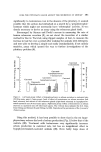
INTER-SPECIES VARIATION IN DERMAL REACTIVITY 379 Mrs. DAVIES: We are all sympathetic with you on these points. The more we move from one species of animal to another attempting to maintain a standard technique so then do points of this kind emerge. Exact comparison of a technique on two species may not be possible. It is perhaps more appropriate to modify the technique for each species. The techniques might then be considered comparable if the different species demonstrate similar responses to a given irritant. It is this variability in technique, however, in the absence of a comparison with a standard technique, which presents one of the major obstacles when trying to compare the published researches of different workers. The work of Justice et al (3) illustrates the attempts being made to find predictive animal tests that give results comparable to those seen in man. De,. C. SCHEN•:: How did you apply controls in your tests? MR. DAVIES: A blank or saline patch is applied adjacent to the test sites. This allows differentiation between the reactions elicited by the test materials, and those induced by the testing procedure (especially by the plaster which holds the patches in place). MR. N.J. VAN ABB•: Taking your results as a whole you are demonstrating in part the difficulties of interpreting patch tests, bearing in mind that toiletries and cosmetics are not generally used in conditions of occlusion. For instance, in the case of the medi- cated shampoo, we all know that reactions of that severity just do not occur on human skin and, therefore, it is extremely difficult to say what significance is attached to severe reactions in laboratory animals. In part, therefore, you have demonstrated the desirability of elaborating a method of open patch testing for all these materials. In our experience (in the Beecham Laboratories) the albino mouse ear does give as good a correlation as we know to be possible with what would be found with open conditions on human skin. MR. DAVIES: I agree that you are unlikely to see in man the response elicited here in rabbits with the cream shampoo. And I further agree, subject to the comments made earlier to Mr. McGee, that there are occasions when the testing procedure might be required to give results more comparable with those seen in man. It may well be that these open patch techniques provide a realistic appraisal of the irritancy potential of new products, but, as with all new methods, it should be equated against the accepted standard techniques. Its use for the initial testing of new products should be assessed most critically until it can be assured that false negative results do not occur. The large reactions seen here in rabbits with occlusive dressings should not be viewed with too much alarm. Rather, it would be advisable to accept the intrinsic irri- tancy of the product and move cautiously to further tests which more realistically indi- cate the possible acceptance of the product under conditions simulating normal use and making allowance for possible abuse. MR. D. M. BRYCE: The formulation in which a substance is presented to the skin can modify its irritancy. I find that 0.5• sodium lauryl sulphate, when applied to human skin as a suspension in an oil, is irritant, whilst 2•o in an o/w cream is without irritancy. MR. DAVIES: I cannot agree with you more, as we have found exactly the same problem. The choice of vehicle may have profound effects on the observed reactions. We have tested sodium lauryl sulphate in a number of vehicles, and here we used an aqueous solution.

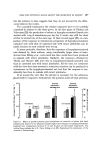
380 JOURNAL OF THE SOCIETY OF COSMETIC CHEMISTS M•t. J. McL. PHmx,: I would like to draw attention to the start of your paper where you say the rabbit is used most frequently and this selection is seemingly based on historical and practical considerations rather than on scientific evidence. In your presentation you have shown that the rabbit is possibly the most sensitive reactor to skin irritation. Do you confirm what, I would have said, has been known for 15 years, largely as a result of practical work by the FDA and a considerable amount of scientific attention by them--do you confirm that9. In which case I would agree with you. It is valuable to know that there is one particular species which is a little more sensi- tive in its reaction than the human, and it is valuable to know that there is a species less sensitive. It is valuable to know, as Mr. Van Abb6 was suggesting, that there might be a species and a part of an animal that is very close to the human. It is up to the intelligent investigator to use the species that he thinks is desirable for his endpoint, and to interpret the results relative to the product that is being tested and how it is going to be used. Earlier to-day we heard the possibility that there would be official tests, and I think the little discussion we have had here indicates the pitfalls. One side says we have an official test, the other side says we will use it, and in between you have the laboratory prepared to do it, but not necessarily to interpret completely to the sponsor what the test means, or the sponsor not completely willing to accept the interpretation. This is one of the troubles that we have seen in the U.S.A. and does call, I think, for the greatest possible attention to the interpretation as well as to a consideration of such species variation as you have covered. I think your illustration does show very clearly indeed the difficulties in official tests applied to a whole series of animals, and it probably relates back to the FDA finding that keeping the occlusive patches on the animals was the first and most difficult part of the exercise. M•t. Davits: Thank you for your comments which clearly indicate some of the basic problems in predictive testing. I would emphasize that any conclusions drawn from the data here may need quali- fication in the light of further experience. Thus, although the rabbit proved to be the most sensitive species here, and this is in agreement with my own experiences and those of the FDA and others, nevertheless there is at this time a limited knowledge of the sensitivity of other species. Undoubtedly the crux of predictive testing is the interpretation of the results, and this problem is heightened if the investigator is prevented from using the test species and procedure appropriate for the product being examined. Thus, the concern which the Society feels about the possible introduction of legislative controls within the next decade is well founded. The legislators need to spell out specific procedures and yet it is apparent that there is no one test that is appropriate for the assessment of all new cos- metic and toiletry products. Legislators tend to use phrases such as 'the expert opinion of the moment' and I feel these terms might well be applied here. M•ts. H. Btyri•.•t: You mentioned that it is important to show comparisons between chemicals. However, you used 100K propylene glycol, and I am concerned for the in- dustry that your results give the bad impression that propylene glycol is an irritant. If this were compared with 1005/o glycorine I think you would find similar erythematous reactions. Glycorine is a dehydrating agent at 100•o and only acts as a moisturizer when it is a 30• solution. I would, therefore, like to see glycerine compared with propylene
Purchased for the exclusive use of nofirst nolast (unknown)
From: SCC Media Library & Resource Center (library.scconline.org)