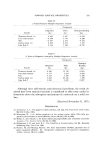
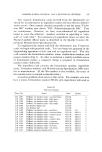
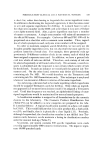
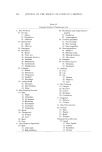
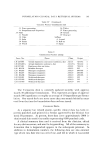
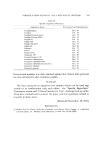
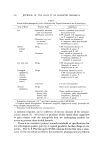
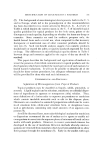
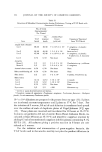
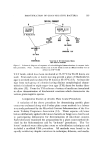
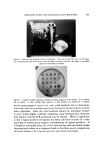
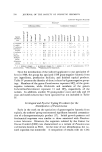
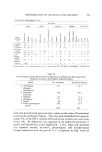
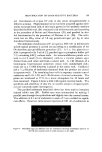
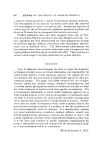
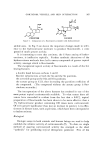
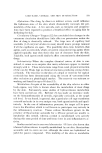
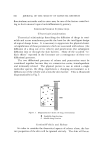
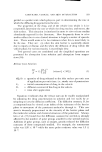
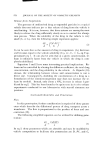
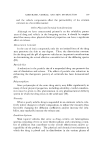
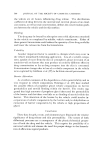
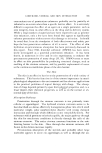
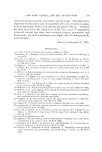
FORMULATION-CLINICAIJ DATA RETRIEVAI. SYSTEMS 5.1.3 Table VI Specific Ingredient Dictionary Ingredient Name Termatrex Card Identification Acetophosphate Red 85 Acetulan Yel 00 Acetylated lanolin dervt Grn 78 Acridine Orange RRR Grn 50 Acrysol A1 Yel 69 Adipic acid Grn 51 Albagen No 4439 Grn 79 Alipal-All Red 86 Allantoin Yel 70 Alon C Yel 01 Alrosol C-All Yel 02 Alrosperse 1 IP Grn 80 Alunfina hydrate C-3I Grn 52 Aluminum chlorhydrate Red 75 Aluminum chlorhydroxide Grn 81 Aluminum chlorhydroxy allantoin Grn 76 Aluminum chloride Red 87 Aluminmn powder Grn 82 [ortnulation number was then checked against the clinical data printout for data obtained in skin irritation studies. SUMMARY We have presently in operation two systems which can be used sep- arately or in combination with each other: the "Specific Ingredient" Termatrex system and "Clinical Sensitivity Test" desk-top look-up table. They have worked well to answer the more common questions related to research in these areas. (Received November 12, 1971) REFERENCES (1) Starker, Lee N., Owen, Katherine Crawford, and Batson, Betty Cooper, A multi-level retrieval system. II. Medium-sized collections, J. Chem. Doc., 9, 161 (19•9).

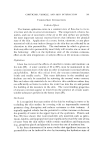
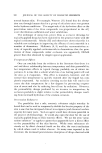
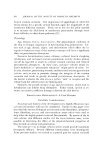
]. Soc. Cosmet. Chem., 23, 545-548 (August 17, 1972) Determination of Copper-EDTA in Cosmetic Products B. L. KABACOFF, B.S., GEORGE MOHR, and C. M. FAIRCHILD, B.S.* Synopsis--The determination of COPPER-EDTA, the sodium salt of the (ethylenedinitrilo)- tetraacetic acid chelate of Cu(II), which reflects its stability in cosmetic products is described. The analytical method consists of shaking an aqueous dispersion of the cosmetic product with an ION EXCHANGE RESIN, washing the resin free from extraneous matter, and eluting the copper-EDTA from the resin with sodium bisulfate solution. The concentration of copper-EDTA in the eluate is determined by SPECTROPHOTOMETRIC MEASUREMENT of its absorbance at 750 nm. INTRODUCTION Copper-EDTA, the sodium salt of the (ethylenedinitrilo)tetra- acetic acid chelate of copper(II), is a blue coloring matter roughly ap- proximating the color of FD and C Blue No. 1. It has been found to be much more stable to light then the latter dye (1). The affinity for copper(II) of EDTA is quite high, the stability con- stant (pK) being 18.3 (2). Nevertheless, it is conceivable that some com- ponent of a cosmetic formulation may have sufficient affinity for the cupric ion to remove it by exchange from the EDTA anion. Conse- quently, a method of quantitative isolation of the copper-EDTA anion from the product would result in an assay that would reflect its stability. The method of isolation of the anion used in the work reported here is absorption on an anion exchange resin in the chloride form. The cop- per-EDTA anion has a greater affinity for the resin than the chloride ion * Revlon Research Center, Inc., 945 Zerega Ave., Bronx, N.Y. 10473. 545
Purchased for the exclusive use of nofirst nolast (unknown)
From: SCC Media Library & Resource Center (library.scconline.org)