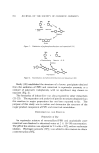
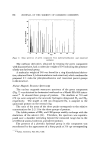
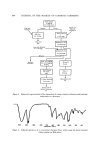
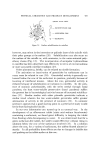
888 JOURNAL OF THE SOCIETY OF COSMETIC CHEMISTS (2). It is obvious that the formulations needed to achieve the product requisites and physical forms are an analytical chemist's nightmare when he tries to analyze them. SURVEY OF SHAMPOO ANALYSIS METHODS Shampoos have been identified by a number of workers as examples of complex mixtures of surfactants which present difficult problems for analy- sis (4-6). Various methods are used by these workers to classify surfac- tants, including functional group analysis (7), elemental analysis (6), and paper chromatographic separation and identification (6, 8). All methods used are qualitative or semiquantitative, at best. Specific references to the analysis of shampoos are not plentiful in the literature. The earliest dated reference in the chemical literature is by Rosenberger (9) who published qualitative and quantitative methods for determining soap and inorganic salts in shampoo powders in 1938. In 1942, Ram (10) reported the analysis of an alkali sulfate and an alkyl sul- fate or sulfonated oil in the presence of each other in another shampoo powder. Ram's work is the first reported analysis of a synthetic deter- gent in a shampoo. In 1949, Parisot (11) described an analytical scheme applicable to liquid shampoos. From a single sample, he separated by solvent extrac- tion the free fatty acids, fatty acids combined in soap, fatty acids in un- saponified material, the unsaponified material itself, and sulfonated deter- gent. Other components were determined on separate samples. In 1958, Newburger (12) described the analysis of shampoos using ion exchange resin. Figure 1 shows an abbreviated scheme of analysis. Note that the method is applicable to shampoos containing an alkyl sulfate, a fatty acid-alkanolamine condensate, and soap. This method is still useful for shampoos with these components. Bush (13) cited the Newburger paper in his review of analysis in the cosmetic industry in 1959. He indi- cated the potential error in attempting to determine an alkyl sulfate by hydrolysis if a fatty alkanolamide is present and suggested that the deter- mination of an ester value of the separated fats after hydrolysis is a reliable indication of the presence of a fatty alkanolamide. Since alkanolamides are not easily extracted from shampoos by ordinary methods, Bush sug- gested the use of ion exchange techniques. Neu (14) and Mapstone (15) contributed methods for determining the foaming properties of shampoos and improving the AOAC water deter- mination (16), respectively. Others dealt with problems of viscosity de- termination (17) and phosphoric acid emulsifiers in egg shampoos (18).

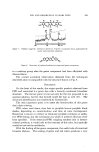
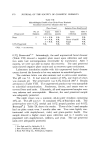
ANALYSIS OF SHAMPOOS 889 Sample •n Acidified Alcohol I • Acidified Alcohol Weakly Basic Ion Exchange Column Alcohol Eluate I Amm.(NH412CO 3 Eluate I [ Evap.-Dissolve I NH 4 Alkyl Sulfate lin Water r: Na2C031 /Evap.-Ext. Acer. I Søap-Na2C03 Residue I Extract H20-Acid I Fatty Acid-Alkanol Ext.
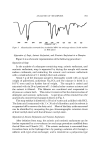
Hot CHCI 3 Amine Condensate Fatty Acids Simplified schematic of Newburger's shampoo analysis scheme (12) Newburger was the first to use infrared spectroscopy in shampoo anal- ysis (19). The spectrum of the nonvolatile residue was examined for the possible presence of soap, alkyl sulfates, alkanolamines, fatty acid-alkanol- amine condensates, polyoxyethylene compounds, polyhydroxy com- pounds, and quaternary ammonium compounds. Other qualitative tests were used and water was determined by the AOAC method (16). Separa- tion of the surfactants was by the ion exchange method (12) and is shown in Fig. 1. The separated fractions were examined by ir and identified by their spectra. Although the procedure outlined is quite comprehensive and makes very good use of technology available, it cannot separate and identify alkanolamines which are popularly used in many modern sham- poos. Puttham (20, 21) applied another ir technique to qualitative and quan- titative analysis of surfactants in shampoos. He used a Teflon ©* seal with a backing plate on the back face of a KRS-5 attenuated total reflec- tance (ATR) prism forming a cell to contain a liquid shampoo which can be scanned by ir. Spectra obtained over the "fingerprint region" were used to identify an ethoxylated alcohol, a sulfated alcohol, and a sulfated fatty alcohol ethoxylate. The qualitative method was adapted to a quan- titative method for lauryl ether sulfate by measuring the sulfate absorbance * E. I. dupont de Nemours Corporation, Wilmington, Del.
Purchased for the exclusive use of nofirst nolast (unknown)
From: SCC Media Library & Resource Center (library.scconline.org)